
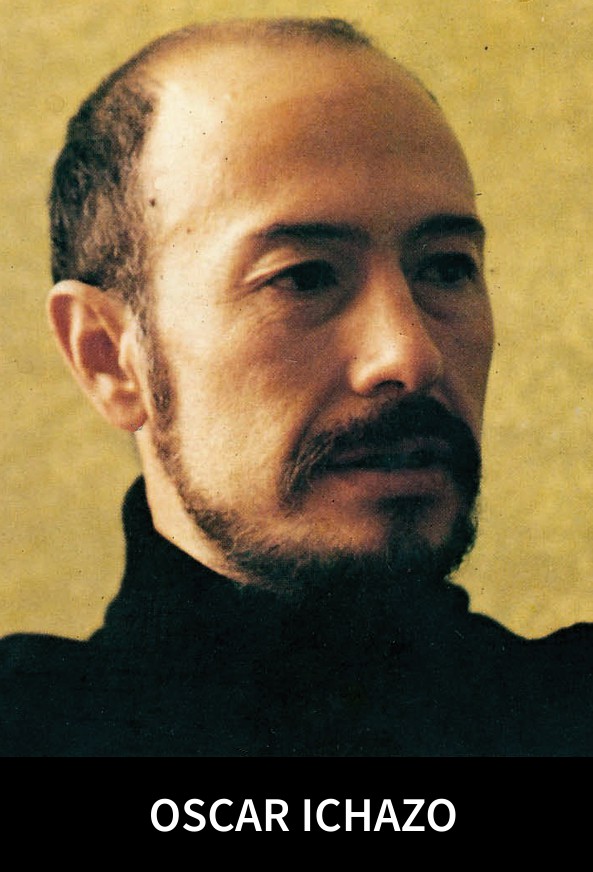
Oscar Ichazo and his Arica Institute
The Beginning or Failure of a New Tradition?
On September 28th 1971 a full page advertisement titled with the Zen saying “The Mosquito that bites the Iron Bull” appeared in the New York Times. It announced that a school was opening in New York City offering a three month residential training beginning on Oct 5. There was an extensive curriculum of “44 overlapping stages” ending with “Meditation in the Void” THE PERMANATE 24. The text of the advertisement mentions an unusual Chilean Master named Oscar Ichazo, a man who himself had studied under many masters and therefore was able to teach a wide range of disciplines. At the time Ichazo was virtually unknown in New York. However, within a community of people in what was to be called the human potential movement he was very well known. Within this group, centered primarily at the Esalen Institute located in the Big Sur region of California, Ichazo had created a huge wave of interest and excitement. This man was thought by many to be the successor to G.I Gurdjieff. The wave he created carried a number of people associated with Esalen first to Chile and then back to The United States and on to New York City where Ichazo believed there was a great concentration of people who were ready for his teaching. This article will explore the man, his teaching and the school, named Arica that he formed
Ichazo (July 21, 1931 – March 26, 2020) was born in Boliva. [note: this article was written before Ichazo died and has been updated a bit] We know very little of his early years except what he has told various people as well as information contained in a few interviews he has given over the years. There has been a substantial degree of “movement” in what he said, particularly in those areas related in some way to his teaching. His original religious affiliation was Roman Catholic, but this was not the source of his interest in the mystical. According to Ichazo, at about the age of six and a half he began to have violent “attacks.” These attacks, which continued for years, occurred between the waking and sleep states and they took him out of the body. “When you are in your Astral body, both fear and ecstasy can be multiplied to infinite proportions because there are no limits within pure consciousness.” The church offered no explanation and so he began to search. “I started reading everything I could find on anatomy, physiology and medicine with the hope of finding out what to do about my condition… I started samurai training and had my first introduction to Zen meditation….The Indians introduced me to psychedelic drugs and shamanism while I was in my early teens. I also began to experiment with hypnotism and to practice yoga…while reading all the philosophy I could get a hold of.”
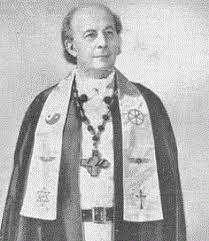
While attending university in La Paz, Ichazo at age 19 had an encounter with what he terms “a remarkable man.” According to Ichazo this man, a European, was a member of an esoteric group in Buenos Aires. Somehow Ichazo became the “coffee boy” for this group. “I would get up at four A.M. to make their coffee and breakfast and would stay around as inconspicuously as possible…they started to use me as a guinea pig to demonstrate techniques to each other… about two thirds of the group were Orientals, so they were strong on Zen, Sufism and Kaballah. They also used some techniques I later found in the Gurdjieff work.” Eventually, Ichazo was accepted into the group and after proving himself, they taught him for two years. There is an apocryphal story of his initiation into the group. Ichazo was required by his teachers to sit in a lotus position on a post for three days. When they returned, Ichazo’s body was so rigid he had to be lifted off the post. Back in his hut, Ichazo’s personality structure broke down completely, after which he was transformed. When he went to the apartment where his teachers were, he found the men waiting for him. Now, they said, he could join the group. There are other versions of the story about his encounter with this esoteric group. Another, given by Ichazo in an interview published in LA Weekly in 1993, provides a different view. “When I was 19 years old in La Paz, I was introduced to a European businessman who was living in Buenos Aries. We talked about Kabbala and the alchemical lore rehashed by German occultists like von Hartman and List. He was interested in what I was saying, and said to me, ‘Have you read the books of P.D. Ouspensky?’ And he lent me two recently translated books Tertium Organum and In Search of the Miraculous…He said we have a small study group in Buenos Aries. If you want to come, you’re most welcome.” In this version Ichazo went to Buenos Aries, was well received and immediately accepted into the group. The members of the group were well off and everything was “first class.” He taught the incompetent “millionaires” how to make coffee. Additionally, the 19 year old informed them that “The thing doesn’t work…This thing of Ouspensky’s doesn’t go anywhere. These people [in his group] don’t know what they’re talking about. They think they are discovering, you know, gunpowder. And it is not so.” It is to keep in mind that this version is given in a 1993 interview. This interview is over 20 years after he began his teaching and the formation of Arica. As we will see Ichazo’s attitude toward Fourth Way teaching and Mr. Gurdjieff radically changed over the years, being molded to fit his evolving narrative.
It is unknown if any of the versions regarding Icahzo’s encounter with this group are accurate. Icahazo tells us that his association with this group opened many doors for him in the East. He claims to have worked with the Buenos Aries group for two years and after spending sometime in Chile traveled to the Orient including Hong Kong, India and Tibet. While in the East “I did more work in the martial arts, learned all the higher yogas, studied Buddhism and Confusionism, alchemy and the wisdom of the I Ching.” Returning to Bolivia he “began to digest” what he had received in the East. After about a year Ichazo went into a “divine coma for seven days.” This seems to be the pivotal experience of his life. “I felt that this experience was it—That I didn’t need to learn anything else. I had reached the totality.” The result of this experience was that he now knew that his path was to be that of a teacher, though it took two years for him to act on his calling. It is unclear if Ichazo maintained his relationship to the group in Buenos Aries and if he was acting on their behalf as he began to teach.
Ichazo says he left Bolivia and headed to Santiago Chile to begin lecturing at the Institute for Applied Psychology. The date of his arrival in Chile is unclear but appears likely to be the mid to late 1960’s. The time line and narrative of his life is confused by his often conflicting statements. According to most accounts Ichazo developed a group in Santiago, eventually deciding to move because “Things got so busy and crowded there…I decided to move to the remote town of Arica and filter out all except the really committed…” A different version of this time is offered on the Arica web site. “In 1956, Oscar formulated the principles of Trialectics or Integral Logic, the logical laws of the mind in the ‘process of becoming’ and upon this foundation originated the theory of Protoanalysis, the doctrine of the Fixations and the structure of the human psyche composed of eighteen Spheres of Existence and Knowledge.” If this is so his time in the East was very limited. Indeed, this version does not speak of any teachers either in the East or West. By age twenty five, 1956 “…groups of people formed in major cities in South America to study the mystical insights, original philosophical theories and the in-depth understanding of the human psyche that Oscar was proposing.” Ichazo’s current narrative of having already established a wide ranging school in South America long before his 1970 experiment in Arica is a departure from what had been previously presented by both Ichazo and the people he worked with, and should be viewed with some deserved skepticism. Again these sometimes radically different versions that have been presented seem to be given for the benefit of the Ichazo story de jour. The narratives at the time given, fit the explanation(s) of how Ichazo acquired his knowledge and developed his teaching. Looked at as a whole they present at best a confusing and contradictory account. At worst they call into question the credibility of both his life story and his teaching.
The Esalen Connection

By 1969 word of Ichazo had reached the Esalen Institute. Several people associated with Esalen went to Arica, Chile to investigate the man and his teaching, among them was Claudio Naranjo. Naranjo, a Chilean psychiatrist, friend of Carlos Castaneda and Gestalt Psychologist Fritz Perl’s apprentice, Naranajo was an active Esalen participant. Naranjo had received letters from friends speaking of their experiences with Ichazo, of having experienced states that had previously only been achieved with drug use. He corresponded directly with Ichazo but had some doubts. Regardless, he went to Chile to meet with him. Naranjo was not impressed by Ichazo as a person, did not like him but “had an impression of tremendous knowledge.” Naranjo was, as his friends had been, given experiences he had only achieved through the use of drugs. After these experiences and convinced as to the depth of Ichazo’s knowledge as well as his ability to directly transmit energy, Naranjo himself decided to take the training. This decision influenced many others to also sign on.

Another man interested was John Lilly. Lilly, a psychiatrist famous for his dolphin research, was also an LSD researcher and at the time an Esalen resident. Lilly, separately from Naranjo, decided to go to Chile, spend a week to meet Oscar Ichazo and see “what sort of person he was.” What he found was a man who had been to and could discuss the “same spaces” Lilly had experienced in his LSD and isolation tank research as well as a near death experience. He found Ichazo to be a visually an unimpressive man but nonetheless, “There is the expert’s economy of movement, of his use of energy, in facial and body usage. He had a repose, a meditative relaxing from which his movements originate.” A group of four Americans were already immersed in training, acting as Ichazo’s guinea pigs in order to determine what specifically the coming North Americans needed in their training. With Ichazo’s permission, they informed Lilly of what they were doing. It was a rigorous program that began at 8 A.M. and finished at near midnight, including special physical exercises as well as chants and mantras. Lilly, while still holding doubts, decided to come back for the full 10-month training.
Ultimately in late spring of 1970, a group of 54 Americans arrived in Arica Chile, a seaport city on the edge of the Atacama Desert. The Americans journeyed south for what was to be a 10-month session of spiritual training. These men and women put their lives and careers on hold to devote themselves to working with a man who nobody knew much about and who had no published writings. Most were in some way directly or indirectly associated with the Esalen Institute. As Dick Price, co-founder of Esalen, said “Arica cleared our bench.”
Work began in late June early July with “…physical exercises called the “gym” for two hours a day, five to six days a week…auditions for an hour, chanting for another hour and mentations…for an hour or two and finally in the evening group exercises…” There were special exercises on Sunday. The group met in the desert for a very rigorous set of exercises called the “Pampas,” which involved walking in special ways, carrying rocks and praying. The Pampas exercises took two to three hours to complete. Ichazo also lectured during which he taught mantras and chants. Notes were taken during the lectures in one journal, while another journal was kept to record the internal experiences of the student. Ichazo developed a scale of what he termed “Satoris” which were various states of consciousness. He used Gurdjieffian vibrational numbers with 48 being the neutral state +24, +12, +6, +3 being positive Satori, and -24, -12, -6, -3 being anti-Satori. The anti-Satori states correspond to Gurdjieffian vibration levels of 96, 192, 384 and 768. The generalized “goal “of the work was to experience the higher states. Apparently, from what are the stated experiences of the students, much was accomplished during the training. It was said that drugs were being used by at least some members to enhance their experiences and that LSD was used during some of the group exercises. The Arican word for LSD was ladiyat. At the time LSD and Marijuana, called MRC were accepted, though generally not supposed to be used during trainings. However, there was wide spread use of the drugs by Aricans. Both of these drugs, at low doses, were at times used in conjunction with exercises that were given after the trainings. In the early years of Arica, only addictive drugs were forbidden.
While the majority of the 54 Americans completed the training, Naranjo and four others were asked to leave. Lilly also left after 7 months in February of 1971, but of his own volition and on what he believed at the time to be good terms with Ichazo. “After six months of introductory exercises, a new phase of more intense training began.” We have no full report on what occurred towards the end of 10 month training, Ichazo’s apparent goal was not to advance the individual’s vibrational level per se but to create a school/group of a high vibrational level with which to initially take his teaching to the United States, and then on to the world. In order to do this, the training was focused on exercises that led to raising the individual’s level of vibration thus leading to the experiencing of higher states of consciousness that in Arican terms would mean Satori of 24 and up. Ichazo, as Naranjo said, “had an” incredible bag of tricks” to make this possible. There was also other work of a more psychological and theoretical nature. This work was at the time centered on “ego fixations,” “ego deviations,” and related work of ego reduction. There were seven basic enneagrams Ichazo developed that were used to help analyze and classify both the individual student and the general psychological condition of all men. About 44 people completed the 10-month training and would form the core of the Arica school that Ichazo established.
After the South American training ended in April 1971, the newly fledged Aricans returned to California, many to Esalen. There was much enthusiasm, a high level of energy, and after taking some time off, many headed to a big house on Long Island to begin to prepare for the next training at what was now to be called the Arica Institute. The training was to take place in The Essex House Hotel where the group would live and work. Ichazo’s idea was to create a spiritual community in the heart of New York City and that would somehow influence the culture. The full-page advertisement was taken in the New York Times and a phone bank set up to handle inquires expected to be generated from the ad. There were some calls but very little came from the advertisement, perhaps one student. Thus the expected onslaught of “people prepared for reality” did not occur. Ichazo was unknown, his teaching was unknown, the ad a mere curiosity. There also was an early October article in the Times, mostly favorable and then nothing. Perhaps the cost of $3000 not including room and board was off putting. The training began on October 5, 1971 and was to last three months, some 70 or so people participated. John Lilly was in dispute with Ichazo over his desire to publish a book that included Ichazo’s teaching and did not participate. However, his wife Antonietta (Toni) attended the training and she reported: “The type of training I experienced during the three months was a combination of Gurdjieffian, yoga, high school gym and some tantric yoga…we sat in front of the school symbol for twenty minutes a day, with a strobe light impressing the symbol… focusing approximately fourteen hours a day, six days a week for three months, on the training.” Lilly’s Book Center of the Cyclone, a portion of which deals with Ichazo and the Chile training presents an over all quite positive view, but was seen as a threat by Ichazo. The book’s publication became a wedge between Lilly and Ichazo. At this point Ichazo had no significant published material and is presumed to have felt Lilly was giving away too much information. Ironically, Center of the Cyclone became a great recruiting tool for Arica, very likely creating much of Arica’s initial growth.
According Sterling Doughty to another participant of the New York and other trainings, “It’s important to note that in Chile and the 3 month and [the later] 40 day trainings the basic ego-essence idea, transformation: asleep-awake, self-observation, centers, etc. were pretty much identical with G’s work as described by Ouspensky.” Regarding the specific New York training Doughty said, “The training was very well structured and contained all the elements in the ad. We worked full days, with Saturday off and Sunday had special exercises. There was a 300 page photocopied manual with a full schedule. Many of the exercises worked fantastically. But the aim, Permanent 24 (basic satori) wasn’t reached. People got high, some stayed high for a long time and some went in and out, but the awakened State (which I presume most everyone got at least for a while in the training) was not a permanent state.”
After what has been described as a successful New York training ended, another institute was set up in San Francisco. Additionally, there remained an annex group in Arica though clearly the central locus was to be the United States. Trainings continued but after five sessions (3 in New York, 2 in San Francisco) the three-month trainings came to an end. In 1975 Ichazo says of the two original trainings in Chile and New York “… we worked the Arica system in parallel with a careful selection of the most important traditional techniques…it was the aim of these trainings to develop teachers….so they could lead their students with the necessary experience, competence and security…about two years ago …I began teaching Arica Theory and System almost exclusively in…Arica Houses that have since grown in number to seventy-five throughout the United States, Europe and South America.” In Chile, Ichazo was available and directly involved in training. During the New York training, he was beginning to rely on his trained “teachers.” Reported as being surrounded by an inner circle, many from the original training in Chile, access to Ichazo by “ordinary” students diminished.
By July of 1975, Ichazo felt his school was complete. “This is fantastic…I knew with precision…I told the Chile group its to be five years…it’s five years, and the thing is finished.” When asked what he meant by “the school is finished.” He replied, “…to have the first group of realized men (emphasis added) with these techniques…We had to do this process because it is the incarnation of humanity as a whole.” Ichazo’s larger aim was to save humanity by creating a new man, and a metasociety first with his school and later with humanity at large. He thought that would take about 10 years. It is unclear when Ichazo thought the 10 years would begin. However, in a 1976 interview he was asked: “about three years ago we were told that humanity had only ten years to solve its problems. So can we expect seven years from now?” Ichazo replied, “Yes. No more…it has taken time…until we reached the necessary level…Now in Arica we know exactly what has to be done… everything has been measured and proven…in hundreds of persons…we had to form a body, truly a body…we are already a metasociety.” Ichazo felt that the Aricans were like catalyzers whose vibrations affect those they come in contact with thus affecting humanity in general and ultimately creating a metasociety on the Earth. “I call it a metasociety because… it is really beyond what we know now…a point where there are no longer relations, but there is unity…a society of relations is a society of fighting…of battle and of contradictions…that is its level.” In the metasociety Ichazo envisioned there would be unity based upon people knowing their psyche so well that “they could read each other completely.” Ichazo believed that such a society already existed in his school, Arica where there was no relation but only unity. “If unity doesn’t exist then the defense mechanisms of that organism, the body of Arica are instantaneously produced. If someone is not in unity with another, the other person reduces him, reduces his ego…his personal position.” Ichazo saw this “ego reduction” in conjunction with a “complete” knowledge of the human psyche as the way to unity and man’s path through the problems that were upon the world. “…extinction is going to come from all sides—pollution, overpopulation, etc. We are so near the precipice, so close to chaos, that we must simply stop and meditate.”
Ichazo brought a complex, intellectualized teaching that is presented as the first “scientific approach to mysticism.” This is a teaching, at least at the theoretical level, that is not very accessible or likely to be of interest to a person of average intelligence or educational background. The teaching purports to have completely mapped the human psyche, which is said to consist of nine levels. “In the first level of the Arica method, we study the nine hypergnostic systems manifested in the three instincts, the four functions, and the two psychic poles which close the circle of the hypergnostic spectrum.” It is only when one gets to the ninth level that it is necessary to have personal contact with the person who originated Arica method. The ultimate “goal” of the training is enlightenment. It was claimed by 1981 that Arica Institutes trainings had reached upwards of 250,000 people Though this number is probably a gross exaggeration, regardless very view of these trainees had any direct contact with Ichazo. From 1976 until 1981 he gave no public lectures and in 1983 Ichazo withdrew to Maui in the Hawaiian Islands. What had started as a more traditional teacher student relationship in Chile, given in almost communal like living arrangements had begun to morph into a series of hierarchical trainings exploring the eight levels of the human psyche, given by “certified” trainers with associated “training manuals.” Though the Arica Institute had “houses” in Canada, Europe and Australia it was centered in The United States.
It is unclear why Ichazo began to withdraw from the public eye. Possibly by 1983, when his predictions of “chaos and extinction” didn’t come to pass, and it was certain that Arica’s influence on events in the world was to be minimal at best, it was time to step out of the public view to avoid difficult questions. It certainly seems the energy his school generated in the early to mid-seventies had long since peaked and that his goal of influencing humanity was not going to happen.
There was one aspect of his teaching that penetrated the growing new age movement, and was becoming more popular and more influential, albeit without The Arica Institute’s direct involvement. This is what is today commonly called the enneagram of personality. After Claudio Naranjo returned to America he began a group in Berkeley California that he called SAT (Seekers After Truth Institute). The name mimicking Gurdjieff’s group of remarkable men seeking a higher truth did have some very thin, tenuous threads to the Gurdjieff Work but was in no way a true Work group, far from it. Regarding the enneagram. Naranjo was to take the basic typology of what Ichazo called ego fixations that he had been exposed to at Ichazo’s training in Arica and through experimentation integrate the enneagram with the language of the DSM 111R (Diagnostic and Statistical Manual 111 Revised) that delineated psychological pathologies. By interviewing many “normal and high functioning individuals” and placing them on the nine points of the enneagram while also aligning DSM 111R’s classifications with the enneagram points he created the basis of what was to become a system of personality typology (personality types) that has to a degree expanded out of the new age community and into mainstream of corporate HR departments.
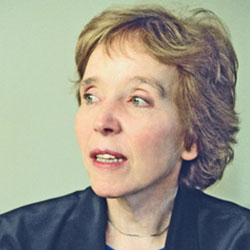
One of Naranjo’s students was Helen Palmer, a San Francisco area physic or as she now refers to herself an “intuitive person.” Palmer took Naranjo’s class and like others Naranjo taught began to “work” with the enneagram on her own, ultimately 1988 publishing a book “The Enneagram.” Until the mid 1980’s little had been published about the “enneagram of personality.” Ichazo had published some sketchy material in which the enneagram or as he began to call it in 1972 or 1973, the enneagon was used as part of his explanation of the psychological part of his nine level teaching of the human psyche. In 1975 John Lilly and Joseph Hart also published some enneagram material as part of a 20 page article titled The Arica Training. In the mid 1980’s, before Palmers book was published there had been full books published that also had their derivation from the Naranjo lectures. These enneagram books, by Catholic enneagram authors, elicited a lawsuit that was settled before trial with no money changing hands and no restriction on the books. All that Ichazo got was a simple acknowledgement that Ichazo was the originator of the theory of ego-fixations and a system of enneagons. Ichazo in response to these early books authored a series of “letters to the school” that were eventually published in book form. The letters are essentially a defense of Ichazo’s system of 108 enneagons as well as the general Arica system.
Despite his displeasure with what he characterized as the plagiarism contained in these earlier books, it was the publication Palmer’s book in soft cover that brought about a lawsuit for copyright infringement that actually went to trial. Arica lost the original lawsuit as well as the appeal. Ichazo in his previous interviews and letters had stated not that he had originated the system but that he had “discovered” the system. “The enneagons…came to me as a result of a long process of investigation, analysis and a careful study of theology, philosophy, and mysticism, and our scientific knowledge of physics, biology, and medicine… I never considered…the set of the 108 enneagons my invention, but a discovery as scientific discoveries are…verifiable and objective.” The appeals court observed “We start from the fundamental axiom of copyright law…that ‘no author may copyright his ideas or the facts he narrates’…Arica publications repeatedly assert that Ichazo has ‘discovered’ the ego fixations, which are scientifically verifiable ‘facts’ of human nature….On appeal, Arica argues that its statements are only metaphoric claims of philosophical truth. Having expressly represented to the world that Ichazo’s theories are factual, however, Arica is not now permitted to make an inconsistent claim so as to better serve its position in litigation.” Inconsistent claims could be said to be a hallmark of the Ichazo story and that he should lose the lawsuit because of this is a remarkable irony. The loss of the lawsuit seems to have been a real blow to Ichazo. The one aspect of his teaching that was really reaching a large and expanding number of people had slipped completely out of his control. Ichazo asserts, in all seriousness, that the use of the enneagram as a slew of enneagram teachers present it, is a partial and dangerous teaching and taken without the entirety of The Arica teaching is at best worthless.
As Ichazo’s teaching and methods evolved, so did his explanations of the source of his knowledge. Ichazo’s attitude toward Fourth Way teaching and Mr. Gurdjieff also changed and became decidedly negative. Certainly, as has been seen, he began to pull away from his early teaching which was essentially a modified mix of traditional methods. The enneagram though was a big problem. Clearly renaming the enneagram as the enneagon was not enough to claim originality, and seemed ridiculous to most observers. He needed a definitive separation from the man he once called “Master Gurdjieff.”
In the Autumn 1991 issue of The Arican, a no longer published booklet, while in the midst of his legal dispute (Arica had already lost the initial case) with Palmer, he responded to Palmer’s letter titled Enneagram Heresy with his own Letter to the Transpersonal Community (here after called Letter). Palmer’s screed is essentially a defense of her using Ichazo’s work to build upon, accuses Ichazo of doing the same with Gurdjieff’s work. Ichazo’s Letter is a rambling, undocumented, essentially incoherent diatribe defending the originality of his ideas while attributing Fourth Way ideas to ancient Greeks such as Plato and the Stoics, the Gnostics, as well as assorted other schools of antiquity. In the Letter he reaffirms his claim that he is the “root of a new tradition” and reveals his growing obsession with the originality of his ideas. “The Aricas theory and method are directly and completely proposed and presented exclusively by me. I am the only source of the Arica theory and method.” The Letter reveals Ichazo’s misunderstanding, and or intentional avoidance of many Fourth Way ideas. Indeed, in his repudiation of the Fourth Way’s “lack of original ideas” Ichazo neglects even mention self- remembering. Additionally, Ichazo makes the mistake of many people. He sees Gurdjieff as the originator of the Fourth Way who took existing ideas and created the teaching he brought first to Russia in 1912. He projects, the simplistic, ill formed view that the Fourth Way is a composite of ideas taken from the Greeks, Stoics and others when in fact the opposite is true. Laughingly this sort of eclectic mixture of teachings is exactly what Ichazo himself taught.
Fourth Way teaching in its origination goes back to Ancient Egypt. This is not the Egypt we know, but Egypt before its religion degenerated into animal worship, when there existed a religion of being. So, of course one finds Fourth Way ideas in many of the teachings and philosophies Ichazo mentions, but the ideas were first found in the Fourth Way not the other way around. By ignoring or claiming to know the origination of the Fourth Way ideas Ichazo only exposes his own ignorance or worse his intentional deceit.
The gist of Ichazo’s letter is that although he admits to exposure to Gurdjieff and Ouspensky’s writings and ideas, it is his opinion that the Fourth Way ideas were either already in existence before Gurdjieff and/or are opposed to the ideas of Arica. In regards the enneagram specifically, it “…is in fact one of the forms known as ‘seals’ which were produced by the Pythagorean school (500BC) and the Platonic mathematicians (300 BC)…” He offers no documentation of this assertion. Many people have attempted to discover a pre-Gurdjieffian record of this symbol. Regardless of Ichazo’s assertions, to date there has not been found a recorded instance of the enneagram prior to Gurdjieff introducing it to his Russian groups. Gurdjieff, of course, never claimed he originated the enneagram, as he never claimed to have originated the teaching he brought to the West. Perhaps, due to his loss in the court system, the idea of origination seems to be or has become of obsessive importance to Ichazo.
If Ichazo had left it as a question of origination that would be bad enough but he goes further in his attack, denigrating Gurdjieffs writings and Gurdjieff himself. Regarding Gurdjieff’s writings, Ichazo says “…I read Beelzebub’s Tales and I found that Mr. Gurdjieff was, in fact, not only mediocre but a very bad writer with no idea of composition or how to develop and present his themes…” Setting aside how one can be both a mediocre and very bad writer, this critique evidences a lack of understanding of Gurdjieff’s legomonism, Beelzebub’s Tales is written on many different levels and cannot be fully understood until a level of being, apparently much beyond Ichazo’s, has been attained.
In his obsession over the origination of his teaching Ichazo first proclaimed that he had severed Arica from all traditional methods he also denied that his ideas have come from beings at other levels of existence, it was all his. It was not always so. “Ichazo has stated that he is in contact with all previous masters of the school, because he is now a master and in the line of succession. He is helped and guided by them. The interior master of all Aricans is called the Green Qu’Tub….”
Since its early days after the Chilean trainings, perhaps prompted by John Lilly’s book and Naranjo’s Institute’s enneagram work, Arica had been very protective of their teaching materials. These materials, all of which were copyrighted, were to be returned after training was completed. Additionally such materials were also, by written contract, to be returned after the death of a student. So we have a contradictory desire to create a metasociety based on Arica teaching as well as a reluctance and or inability to allow his teaching to be put into the world except on Ichazo’s terms and conditions. Arica, in the wake of the lawsuit, seems to have gone reactive, on legal binge in which hundreds of writings, words and phrases were copyrighted, trademarked or service marked. Whether these legal protections would hold up any better in court remains untested so far as could be found. Though as recently as this year Arica has used the threat of copyright infringement to quell what it deemed to be unfavorable writing. Recently a many years long thread about Ichazo, Arica and the enneagram was, under Arica’s threat, removed from the Enneagram Institute website. It is quite understandable that a teacher would want to protect his teaching from distortion and thievery, in this regard in 1990 Ichazo was asked a question at his compound on Maui. “ Is it not possible that the most effective weapon against those that misappropriate the work would be to speed up its appearance in published form?” Ichazo replied “Indeed, I am in that work. We are in that work. That’s what we are doing. Certainly Toham Kum Rah.”
Ichazo has for years said he is working on a book or series of books of the complete Arica theory. In 1975 in an interview he speaks of this, “another point is the discovery of unity by way of reason…it is not formal logic it is trialectical logic…proving the unity of God with trialectical logic means it is possible to understand all that is inside the universe…” When asked if it has been done, he replied “Oh yes. Absolutely. It is just a matter of putting it on paper. I have done it already…I know it by memory…I am desperate to do it, but everything has its time…” In 1986 under “assault and misuse of Arica material by plagiarists…,” Ichazo proposed to put forth “…a deeper vision of the Arica material, that this time can be worked with the general public…a theology about spiritual work with a foundation of true religiosity, directed to the Enlightenment and benefit of all sentient beings…The Arica Way…will offer a history and explanation of the entire Arica material and how to deal with it practically.” To date, nothing has come of these and many other proclamations made regarding the forthcoming magnum opus.
The last major push in to public made by Arica was in 1997 and involved something called the Velocity Training of the Sudden Enlightenment Method. Continuing with his effusively grandiose valuation and promotion of Arica programs, Ichazo said in a 1997 interview in The Enneagram Monthly magazine “The Velocity Training has such great power that it will change the global culture and civilization, because the new paradigmatic worldview presented by Arica is based on a holistic logic that will explain and unify the structure of all processes of the individual, society and the Universe.” The failure to achieve said change to civilization is not really in dispute.
Little has been heard from Arica in the past 15 years. Ichazo continues to live in his compound on Maui. While trainings, including the world changing “Velocity,” are still being offered in many parts of the world, they for the most part are given by Arica franchised individuals or groups and not by the Arica Institute itself. It seems that many of the listed Arica trainers give very few if any trainings. There also appears to now be some sort of tie to a form of Tai Chi Chuan that one of Ichazo’s students who was taught by Cheng Man-Ch’ing incorporated as an adjunct to the Arica teaching. Much as Lilly’s book provided needed credibility and promotion in the early growth days, apparently the Tai Chi training has been a very important factor in keeping some degree of interest alive during what can be described as Arica’s declining years.
It is said his current wife, Sarah, has taken effective control of the Arica organization. The number of members of the Arica is unknown but it has declined and is believed to be substantially less then a 1000 and perhaps less then 500. The future of Arica upon Ichazo’s death would seem to be very much in question. By now claiming absolute origination of the methods and theory of Arica, as well as the need to have direct contact with him as one reaches the ninth level of the school (it is unclear if anyone has achieved this level of enlightenment, it has been said that the work on the eighth level keeps expanding), it would seem that without Ichazo or the oft promised, still undelivered book, The Arica Way, there could not be a completion of the trainings. Without even a mythic completion point it is difficult to see the attraction of trainings such as Arica offers. It may be that some way around this seeming contradiction will be found.
Ichazo’s school, to use the Gurdjieffian language he rejected, has been trapped in a descending octave, creating more “knowledge” and not evolving being to higher levels. In this Arica may well have joined the other teachings that emerged in the late 1960’s and early 1970’s, teachings that grew out of the drug-stained soil of the human potential movement. That the times were very different is evident. Can it be imagined in 2013 that over 50 Americans would go to Chile and most of them complete 10 months “training” working with a little known teacher who had no published material? Was it the openness and perhaps naiveté of the times, coupled with the thirst for a spiritual path, that brought them to Ichazo, or was it the quest for experiences?
For Lilly and Naranjo it was pretty clear that it was experiences and associated knowledge that drove them. Regarding Ichazo’s relationships with these men “… he completely misread Naranjo and Lilly. They had long and well-known history of drug taking with all the false individualism and fantasy, personal and collective, which this entails. As their experiences were not the result of long, disciplined spiritual work on false personality, but instead drug induced, there was no ego-reduction but only a grandiosity masked with an intellectual’s supposed objectivity.” This quote by William Patrick Patterson a teacher of the Gurdjieff Work would seem to be quite apropos to Ichazo himself.
If there was a tread that ran though Arica’s creation and early years, it was that Ichazo provided experiences—his incredible bag of tricks—with a detailed, complex and difficult theoretical underpinning. As the material was read for this article, the word “being” was never encountered as something whose growth in association with knowledge would lead to the enlightenment Arica’s ninth level of enlightenment promised, to that which is “beyond words.” Perhaps because of christening the school with the mantel of “scientific mysticism,” the emphasis seems to have been on knowledge and experiences leading towards a distant goal of enlightenment. While Ichazo seems to have understood the problem of what he calls “ego fixation,” he doesn’t seem to understand how deeply embedded in the nature of man is the general state of egotism, self- love and vanity, and that man carries this with him as he has spiritual experiences and comes to power. As Gurdjieff said: “…the balance between knowledge and being is even more important than a separate development of either one or the other…a separate development is not desirable in any way. Although it is precisely this one sided development that often seems particularly attractive to people (emphasis added)….The development of the line of knowledge without the line of being…[develops] a man who does not understand.”
—Richard Myers— http://www.growingchoongary.com
Notes
- When you are in Oscar Ichazo Interviews with Oscar Ichazo (Arica Institute Press) pp.6-8
- When I was 19 Interview with Michael Goldberg L.A. Weekly Oct 15-19 1993
- I felt that this Ichazo p.134
- One of the things that puzzled many about Ichazo is the question as to where he acquired his knowledge. His stories are varied and contradictory. It is fairly clear that the level of knowledge he presented in the 1970 Chilean trainings was not something, as he would latter claim, he originated. That he personally expanded upon a base teaching(s) creating many parts of the Arica training is quite likely. Ichazo gives a few clues. He speaks of a “remarkable man” he met who sent him to the mysterious group in Buenos Aries. In an interview he also gives the name of one person “Viscount Leo Costet de Mascheville, with whom I worked.” In 1910 Leo Costet de Mascheville’s father Albert emigrated from France to Buenos Aries. Albert also known as Brother Cedaior was an initiate of Martinism as well as several other Western occult teachings. He initiated Leo, his son, into Martinism in 1920. Leo also known as Brother Jehel was also a member of several other esoteric organizations. He taught a wide range of esoteric methods including Sufism, Yoga, Kabbala, Hermetic Science, Martinism, Rosicrucianism, Astrology, Buddhism, Gnosis and others. Jehel later taking on the name Sevananda Swami (the swami was placed after the name intentionally to differentiate from a Hindu swami) started an ashram in the 1950s “… the training of Gurdjieff take turns with the practices pathway Maltre Philippe and Suddha Dharma, with training and practice Martinists, dances of dervishes and Sufis, and exercises of Zen Buddhism.” This all fits the eclectic nature of Arica’s initial training in Chile and New York. It would seem quite possible that Ichazo never went to the East at all, but learned much what he presented working in South America with Sevananda Swami/Brother Jehel/ Leo Costet de Mascheville later expanding it into what is now known as Arica.
- Things got so busy Ichazo P.6
- In 1956 Oscar formulated Biography Arica Institute web site http://www.arica.org/articles/bio.cfm
- Naranjo Report from Chile on Ichazo and the enneagram, Big Sur Tapes http://www.youtube.com/watch?v=Xl1yJjGaDQo There are a series of 7 tapes on the internet where Naranjo is speaking of his experiences in Chile before the main training. “I don’t feel like recommending him… I don’t dare recommend him…but I wouldn’t want to miss it… “ The tapes were recorded at the Eslean Institute.
- There is the experts John C. Lilly The Center of the Cyclone p.140
- Arica cleared our bench Jeffrey J. Kripai Cop out or no Esalen: The Religion of no Religion p.178
- Physical exercises called Lilly p.145
- After six months Charles T. Tart Ed. Transpersonal Psychologies p.332
- Ichazo divides man into two generalized parts, ego and essence. While somewhat similar to Gurdjieff’s division of essence and personality, there were, even in the beginning, differences. Ichazo felt what he called ego fixations, represented by the enneagram of fixations, were the foundation of personality. These are set at birth and can be determined astrologically and man’s personality develops around his particular fixation and related ego deviations. Man is born in a state of complete essence, essentially perfect yet undeveloped and begins to develop his ego in early childhood (age 4 to 6), not from his existence in life but within his life driven by his pre-determined fixations. The goal is to return to a state of pure essence after having experienced the ego in life. “Only when the individual has undergone the difficulties of living in ego can he return to the essential state and have the necessary skills and knowledge to function as an enlightened adult.”
- The type of training John Lilly and Antonietta Lilly The Dyadic Cyclone p.52
- It’s important to note From personal correspondence between the author of this article and Sterling Doughty. A note of acknowledgement and thanks for Mr. Doughty’s help in fleshing out parts of this article of which there was no written record and giving detail and clarification to the written record.
- We worked the Arica Oscar Ichazo The Human Process for Enlightenment and Freedom p.3
- This is fantastic Oscar Ichazo Interviews With Oscar Ichazo p.41
- About three years ago Ichazo pp.68-70
- In the first level Oscar Ichazo The Human Process for Enlightenment and Freedom p.78
- The Enneagons… Oscar Ichazo Letters to the School p.71
- We start from the No. 771, Docket 91-7859.United States Court of Appeals, Second Circuit. Argued Jan. 30, 1992. Decided July 22, 1992.
- The Aricans theory Oscar Ichazo The Arican Autumn 1991 p.116
- Is in fact one Ichazo p.101
- I read Beelzebub’s Ichazo p.90
- The language of Arica was originally a combination of Fourth Way, Sufi Buddhist, Western occult and quasi-Western psychology/philosophy with a scientific veneer; this has changed over the years. We now have a more, new age, occult language with dashes of Egyptian, Tibetan and Hindu derived imagery. Virtually all Fourth Way language has been purged, though interestingly, the term enneagram was resurrected and enneagon retired in about 1996 without explanation.
- Ichazo has stated that Charles T.Tart ed. Transpersonal Psychologies p.341
- Is it not possible http://www.angelfire.com/ar/metaton/ton5a.html
- Another point is the Oscar Ichazo Interviews with Oscar Ichazo pp.53-54
- A deeper vision of Oscar Ichazo Letters to the School pp.30-31
- Sarah Ichazo’s second wife is clearly the force behind Arica today. It is highly doubtful that she will be able to maintain the organization after his death, from a Febuary 2010 Arica Day of Unity titled KNOWING THE TRUTH.
”We have heard that a few Aricans have said that they “don’t need to do any more of the Work.” To hear such a relative remark can actually make one laugh at its blatant absurdity! However, with a more serious look, it is just another obscuration to The Truth, preventing that person from living in The State. All great Teachers do their practice every day without any excuses, questions or exceptions about it. Oscar meditates every day and lives in a glorious State that allows the Barakath to flow into the Mystical School and into each of us. Just writing this, the energy of the School is flowing through me and I am grateful, so grateful to know I was born into this Work. We, as Aricans, were all born into a new tradition, and it is our honor to fulfill our Vows and Offerings, by doing this Work for the benefit of all. We have been given this opportunity to receive the transmission of Oscar through this blessed School, and I, for one, won’t miss it! By remembering that I VOW TO ATTAIN ULTIMATE REALIZATION FOR THE BENEFIT OF ALL, the Work makes the only real sense in a life that is transitory and gone before we know it. Knowing the purpose of one’s life is a precious gift that Aricans can understand and truly appreciate for the benefit of all. Thank you, Oscar.
TOHAM KUM RAH
Sarah Ichazo” - For all his William Patrick Patterson Talking with the left hand P.46
- Did Ichazo ever give up drugs? Probably not. He certainly used them in the early days of Arica. He at one time had a relationship with film maker Alejandro Jodorowsky and was hired to help with making the movie The Holy Mountain “Oscar’s idea of training is two days in a motel room with me taking L.S.D. I want you to know I don’t need Oscar to take L.S.D. in a motel room, I do that plenty enough on my own…”
 Open to Openness