

Book Review
Time and Free Will
An Essay on the Immediate Data of Consciousness
by Henri Bergson
Dover Publications, 252 pp.
It is often difficult to decern an over-arching philosophy through one book, particularly one written originally as a doctoral thesis that was first published in 1889, though written during the years 1883-1887. Henri Bergson was born in 1859 and died in 1941, and so, many years passed between this publishing and his death. With Bergson there was expansion of subject and fine tuning, but there was no later reputation of his ideas as he became more interested in the metaphysical and psychological. Some evolution of the ideas and concepts is evident in his book ”L’Evolution créatrice (Creative Evolution)” published in 1907 as he moves more explicitly to what he calls intuition. Nonetheless, when asked to name the singular foundational idea which was his fundamental and guiding thought, he replied, ”Time is not space.” The subjects of his thesis/book, space, time and free will as experienced in the “immediate data of consciousness” are both complex and of great and continuing interest to both philosophers before and of his time, as well as many individuals who are looking for a certain “something” beyond what Mr. Gurdjieff calls “the hypnotic momentum of ordinary life.” How does Bergson see time and space? Can they be defined? Does man have free will? Can the immediate data of consciousness be used to provide answers?
Bergson’s writing is oddly conversational, at times almost poetic and yet quite detailed and quasi mathematical, as he builds his philosophical arguments. The style is unusual but not compelling, at least to this reader. The original was written in French and the translation to English may be a factor, though this is doubtful. Bergson, born of a Polish father and English mother, became a French citizen 1878 and apparently achieved near cult status in France. “His lectures at the Collège de France were society events reported on the front pages; press photographs of the time show groups of his often predominantly female audience craning their necks in doorways and at windows of packed lecture halls.” His attraction to females extended outside of France and into England and onto the America of 1913, which he visited to lecture at the invitation of Columbia University, lecturing in New York and other cities to large audiences.
The influence and impact of Emanuel Kant is clear through the structure of book. Though Kant is directly mentioned a few times in the body of the book, the conclusion is based around and against Kant. It seems clear Bergson in writing a response in some opposition to Kantian thoughts on matters of space, time, free will and metaphysics in general. Throughout the book there is dualism that is experienced as Bergson sets up the inner-self/outer-self, heterogeneous time/homogeneous space as well as generally a psychological metaphysical/scientific, mathematical analysis. Bergson at times slips back and forth from monism to dualism. While this often appears to be simply his method of “proof’ his movement toward a dualist view of the phenomenal world is well demonstrated in his writing.
Time is Not Space, So What is Bergsonian Space?
Bergson posits space to be a homogeneous quantitative multiplicity, a discrete entity. Objects in Bergsonian space are differentiated within the spatial; the measurable, and given in consciousness, a real existence within this homogeneous medium. ”When we speak of material objects, we refer to the possibility of seeing and touching them; [quantitative multiplicity]…we localize them in space…The case is no longer the same when we consider purely affective psychic states… other than those built up by means of sight and touch.” The multiplicity of states of consciousness Bergson writes, cannot be quantified without “some process of symbological representation [of which]…a necessary element is space.” Kant represents space and time not as things, but as a frame through which objects or the phenomenal world in general, exist and are perceived. Space does not pertain to objects themselves but to the form within which objects are experienced. Space being the frame of the outer world. “Space is therefore to be regarded as the condition of the possibility of appearances, not as a determination dependent upon them. It is the a priori representation which necessarily underlies all outside appearances.” While space may ordinarily appear to be empty, space for Gurdjieff is not empty, it is not merely a frame of perception as it appears to Kant. Rather space is an expanding universe of interpenetrating cosmoses existing in different dimensions and, “Etherokrilno is that prime-source substance with which the whole Universe is filled, and which is the basis for the arising and maintenance of everything existing…all cosmic phenomena in general proceed during some transformation in this same fundamental cosmic substance…it is just because of this…that ‘everything without exception in the Universe is material.’”
And Space is Not Time, So What is Bergsonian Time?
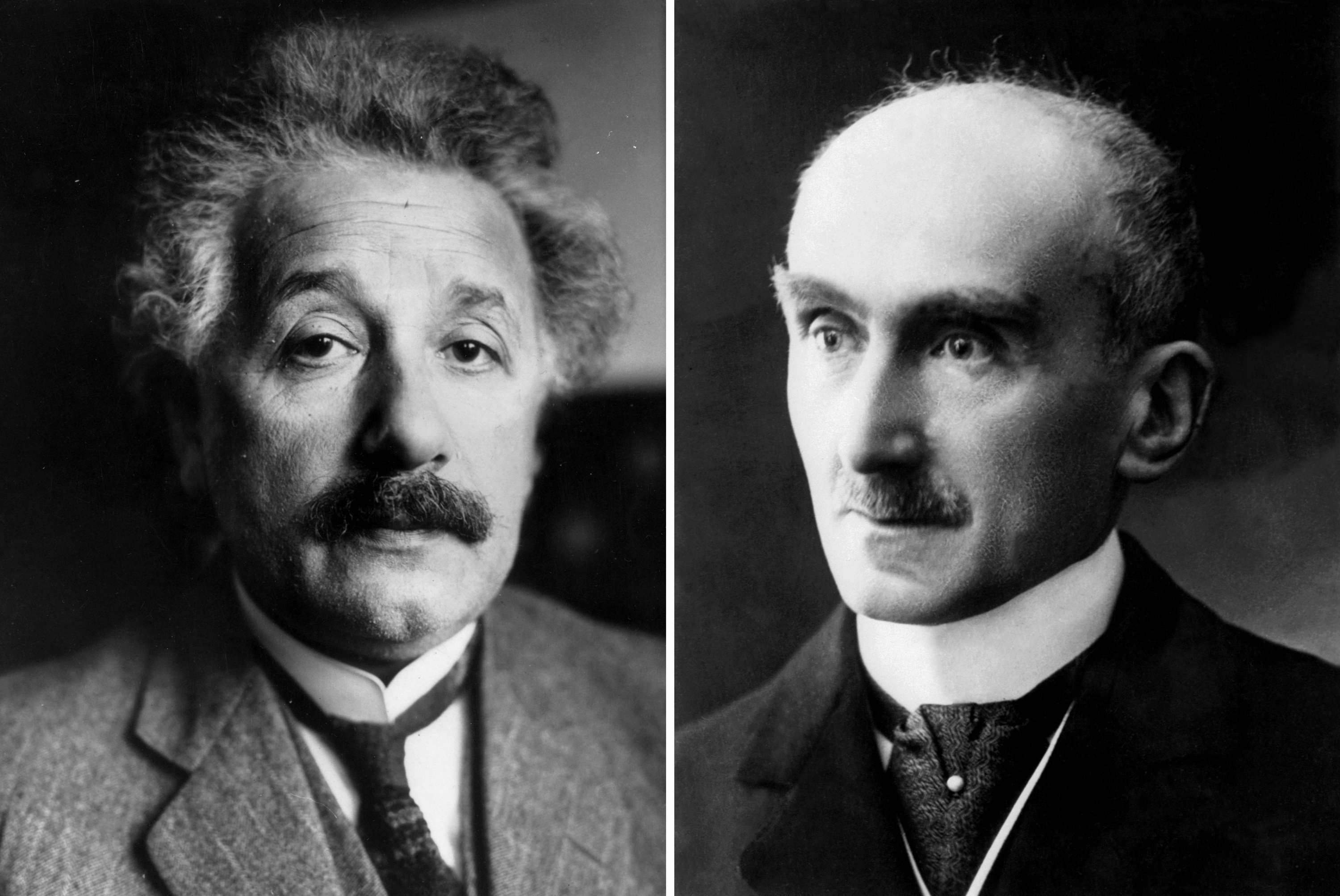
Bergson sees time as a heterogeneous, qualitative continuous multiplicity. In his view, time in essence is real duration made up of moments inside one another, moments which permeate one another, heterogeneous. It only appears homogeneous when it is expressed in space, outside our inner awareness. Time, therefore, is essentially a subjective experience, an inner experience that has no direct connection with space. Bergson writing in the late 1800’s has no knowledge of Einstein’s theory of relativity and therefore states ”…if time as immediate consciousness perceives it, were, like space, a homogeneous medium, science would be able to deal with it, as it can with space.” Further he states, “We have tried to prove that duration, as duration, and motion, as motion, elude the grasp of mathematics: of time everything slips through its fingers but simultaneity, and of movement everything but immobility.” In 1922, years later, with Bergson’s view of time remaining essentially unchanged, Einstein and Bergson would encounter one another and debate these issues. Einstein famously saying, “the time of the philosophers does not exist, there remains only a psychological time that differs from the physicist’s.”
But this book is written as an answer to Kant not Einstein. Kant believed that while space was the frame of the outer world, time was the frame of the inner world. “Time is not an empirical concept that in some way has been derived from an experience, for neither simultaneity nor succession would enter our perception if the representation of time did not enter our perception a priori…We cannot remove time itself from appearances in general, though we can quite well take away appearances from time…Time has one dimension only; different times are not simultaneous but successive (just as different spaces are not successive but simultaneous).” Bergson feels that Kant ‘s biggest mistake was taking time as a homogeneous. “Not noticing made up of moments inside one another moments which permeate one another.” Gurdjieff views time a bit differently, “Time in itself does not exist; there is only the totality of the results ensuing from all the cosmic phenomena present in a given place. Time itself, no being can either understand by reason or sense by any outer or inner being-function. It cannot even be sensed by any graduation of instinct which arises…Only time alone has no sense of objectivity because it is not the result of the fractioning of any definite cosmic phenomena…it alone can be called and extolled as the ‘Ideally-Unique-Subjective-Phenomenon.’”
Time Space
| Continuous multiplicities | Discrete multiplicities | |
| differences in kind | differences in degree | |
| divides only by changing in kind | divides without changing in kind | |
| non-numerical – qualitative | numerical – quantitative | |
| differences are virtual | differences are actual | |
| continuous | discontinuous | |
| qualitative discrimination | quantitative differentiation | |
| succession | simultaneity | |
| fusion | juxtaposition | |
| organization | order | |
| subjective – subject | objective – object | |
| duration | space |
Bergsonian Free Will
Bergson, a bit ponderously, makes his case against both physical and psychological determinism and thus in favor of a sort of freed self. He writes, “We…show…that all determinism, even physical determinism, involves a psychological hypothesis: we shall then prove that psychological determinism itself…rest on an inaccurate conception of the multiplicity of conscious states, or rather duration…we shall see a self-emerge whose activity cannot be compared to that of any other force.” However, Bergson states that free acts are the exception and “Our every-day acts obey the laws of association. At great crises our decisions are really free as expressing the fundamental self.” As to everyday acts he says, “This impression and this idea become tied up with one another, so that the act follows the impression without the self interfering with it. In this instance I am a conscious automaton.” Bergson speaks of two selves. One of which is an external self and a projection for social needs of the other. The inner self “…we reach… by deep introspection, which leads us to grasp our inner states as living things, constantly becoming…which permeate one another and of which the succession in duration has nothing in common with juxtaposition in homogeneous space. But the moments at which we grasp ourselves are rare, that is why we are rarely free.” Certainly, this to a degree, resonates with Gurdjieff’s teaching. Further, Bergson writes that we perceive almost nothing of ourselves but “our own ghost” which is like a shadow projected into homogeneous space. And “we live for the external world rather than ourselves; we speak rather than think; we ‘are acted’ rather than act ourselves.” In Gurdjieffian terms, we don’t remember ourselves, though self-remembering is much deeper and begins with bodily awareness. Bergson is reporting on aspects of our state of waking sleep. So, Bergson gives us the ability to have free will even in our current state, though he limits its possibilities to rare states where the inner self is brought to the fore by circumstance or introspection. Kant, on the other hand, writes that the self as it manifests in the phenomenal world is totally subject to determinism, cause and effect. However, where pure reason reigns and empiricism vanishes, where one may experience objectively “things in themselves” or what is called the noumenal, freedom and what we call free will can be manifest. The problem from a concrete, earthly view is that Kant posits we cannot become agents that in consciousness experience the noumenal; this is beyond a man’s achievable level of consciousness. This drives Bergson into a bit of a rant,”…the only thing left is to turn freedom out of doors, or, if you cannot throw off your traditional respect for it, to escort it with all due ceremony up to the supratemporal domain of ‘things in themselves,’ whose mysterious threshold your consciousness cannot cross.” And, so it goes in the rarefied realms of philosophical discourse. Gurdjieff teaches that a man as he ordinarily exists, that is, as nature has created him, has no free will, only self-will. Gurdjieff broadly classifies these “natural” men by which center is dominate. Man number 1 instinctive-moving-sexual; man number 2, emotional; and man number 3, intellectual. In these men, which represent the vast majority of humanity, “Will is absent… he has desires only; and a greater or lesser permanence of desires and wishes is called a strong or weak will.” Further, Gurdjieff says real will is a function of man number 5, a man with a unified self. And that an ordinary man, numbers 1, 2 or 3, has no unified self, no singular “I.” Instead, these men have a myriad of “I”s which are continually taking charge, receding and being replaced depending on and responding to, the ever changing “external conditions of ordinary being existence.” Can there be real will with a continually shifting “I”? Gurdjieff also says that the natural man lives in a waking state consciousness that is essentially a state of psychological sleep; we don’t remember ourselves. How could a man in this state have real will? Rather than attributing free will to, as Bergson advances, an existing inner self that is rarely accessible, or as Kant writes, a noumenal world that is never accessible, Gurdjieff states that through conscious labors and intentional suffering, we can evolve and increase our level of being and change our state of consciousness to become a man number 5 (man number 4 is in a transitional state). The so-called natural man can evolve into a man who has true self-consciousness, a singular “I” and real will. And yet, even this will does have its limitations, as man is under many laws, and orders of laws. And so, our potential freedom and associated free will are relative. But, as Gurdjieff says, “Man’s possibilities are very great,” though “…he always lives in only a small part of himself.”
—Richard Myers— http://www.growingchoongary.com
_______________________________
Notes
- Time is not space. https://www.the-tls.co.uk/articles/bergson-time-is-not-space/.
- Lectures at the Collège de France. https://www.the-tls.co.uk/articles/bergson-time-is-not-space/.
- When we speak. Henri Bergson, Time and Free Will: An Essay on the Immediate Data of Consciousness (Mineola, NY: Dover Publications, 2001) 85-87.
- Space is therefore. Marcus Weigelt, trans, Immanuel Kant: Critique of Pure Reason (London: Penguin Classics, 2007), 62.
- Etherokrilno is that. G.I. Gurdjieff, All and Everything, First Series, 137-138.
- If time as immediate. Bergson, 234.
- Time is not. Kant, 67.
- Time in itself. Gurdjieff, 123–124.
- Multiplicities Table. https://en.wikipedia.org/wiki/Multiplicity_(philosophy).
- All determinism. Bergson, 142-143.
- Our every-day acts. Bergson, 167.
- This impression. Bergson, 168.
- We reach. Bergson, 231.
- The only thing left. Bergson, 238.
- Will is absent. P.D Ouspensky, In Search of the Miraculous, 42.
- Man’s possibilities. P.D. Ouspensky, 145.
 Open to Openness