
Eternal Recurrence
Thought, Theory or Truth ?
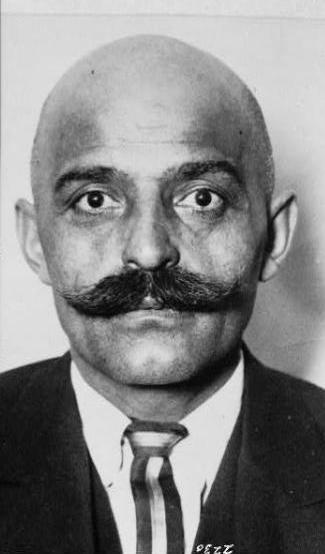
In 1916 while still in Russia, Mr. Gurdjieff gave P. D. Uspenskii, who at the time was in a bit of a funk, the opportunity to ask him any question—“I promise to answer now any question you care to ask, as it happens in fairy tales.” Uspenskii decides “above all” he wants to know what Gurdjieff thinks about “eternal recurrence” and says, “…tell me what you think of recurrence….What I mean is: Do we live only this once and then disappear, or does everything repeat and repeat itself, perhaps an endless number of times….” To which Gurdjieff responds, “This idea of repetition, is not the full and absolute truth, but it is the nearest possible approximation of the truth.” He then goes on to speak of why this knowledge is of little use for work on one’s self and why it is not a part of the teaching. Far from being deterred by Gurdjieff’s words, Uspenskii’s “hobby” of eternal recurrence would be a driving force for his life and explorations, quite literally until his dying day. So from where did this idea of eternal recurrence or, as Gurdjieff called it, “repetition” arise? Is repetition just another word for eternal recurrence or is there a difference? Why does this concept feel strange and outside of how time, as continuous and linear, is generally experienced? Is there any proof of this “…nearest possible approximation of the truth”?
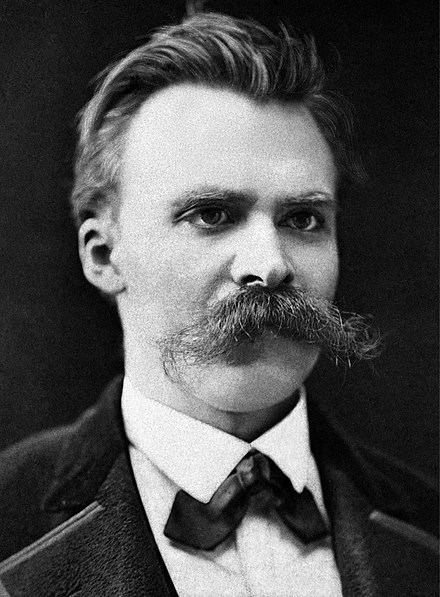
Nietzsche’s Eternal Recurrence of the Same
While for many people the theory of eternal recurrence has come to be associated with Friedrich Nietzsche, the idea appears to have an amorphous origin, though it predates Nietzsche by at least several millennia. But before going to the origins, let’s look at Nietzsche. The concept is said to have come to him “… in the landscape of the Oberengadin, which Nietzsche visited for the first time during that summer of 1881…The thought of eternal return was not discovered in or calculated from other doctrines. It simply came.” While it may initially have seemed to Nietzsche a new discovery, this seems quite unlikely; further, the reality is that it was not. For a man as well read (though at some point he did stop reading) and highly educated as Nietzsche, it would seem to be nearly impossible that he had never come across this idea in some form. Much more likely, the context and relationship of the idea correlated with his struggle to form a reasonably coherent philosophical system. “Nietzsche’s philosophy is neither a unified, closed system nor a variety of disintegrating aphorisms, but rather a system in aphorisms.” [Emphasis added.] The eternal recurrence of the same is the idea that put his philosophy of seemingly random and scattered aphorisms into a system of aphorisms—eternal return enframes Nietzsche’s philosophy.
We first come across the idea directly (or rather as directly as Nietzsche can deliver) and detailed in the now confusingly named The Gay Science. “The greatest weight.—What, if some day or night a demon were to steal after you into your loneliest loneliness and say to you: ‘This life as you now live it and have lived it, you will have to live once more and innumerable times more; and there will be nothing new in it, but every pain and every joy and every thought and sigh and everything unutterably small or great in your life will have to return to you, all in the same succession and sequence—even this spider and this moonlight between the trees, and even this moment and I myself. The eternal hourglass of existence is turned upside down again and again, and you with it, speck of dust!
Would you not throw yourself down and gnash your teeth and curse the demon who spoke thus? Or have you once experienced a tremendous moment when you would have answered him: ‘You are a god, and never have I heard anything more divine.’ If this thought gained possession of you, it would change you as you are or perhaps crush you. The question in each and everything, ‘Do you desire this once more and innumerable times more?’ would lie on your actions as the heaviest weight. Or how well disposed would you have to become to yourself and to life to crave nothing more fervently than this ultimate eternal confirmation and seal?”
Directly following the above quote, we are introduced to Zarathustra in a section entitled Incipit Tragoedia,which ends book four of The Gay Science and is almost identical to the beginning prologue of Thus Spake Zarathustra, Nietzsche’s next and most famous book. Zarathustra, loosely patterned after the Persian teacher/prophet, Zoroaster, functions as Nietzsche’s mouthpiece and is the teacher of eternal recurrence. Zarathustra expounds in imagistic and poetic language on many and varied topics presenting Nietzsche’s philosophy through the guise of a not yet perfected, though much respected, human being. Zarathustra is called to descend from his cave in the mountains and “go under” into the world of men. Having received much knowledge, “…I am weary of my wisdom, like the bee that hath gathered too much honey; I need hands outstretched to take it.”
And what is this knowledge Nietzsche-Zarathustra brings? Varied aphorisms, parables relating to man’s existence, but the impetus for this “down going” was more than a heavy burden of “knowing.” Nietzsche writes, “After Buddha was dead, his shadow was still shown for centuries in a cave—a tremendous, gruesome shadow. God is dead; but given the way of men, there may still be caves for thousands of years in which his shadow will be shown. —And we—we still have to vanquish his shadow, too.” What is it that arises among men when God is dead? And his shadow is vanquished? This is a central idea and concern that Nietzsche spoke to. What was happening around him at the time was a rising of a nihilistic Europe, throwing off the “Thou shalt” shackles of the Christian church and opening to the “I will,” the will to power of other possibilities. With our knowing what happened—WWI, WWII, Fascism, Nazism and Communism—his concern was quite prescient.
By using Zarathustra, whose historical counterpart exists only in cloudy reports and had no European followers, Nietzsche could employ a near mythical figure to bring forth his philosophy. The book, though difficult, has an interesting resonance due in part to its presentation as ancient wisdom in mythical form. Some significant part of Nietzsche wished a return to a different type of human life before or without the Christian God—time and life was cyclical in illo tempore (in those days). He had little use for Christianity or religion in general, but was drawn to a world of nature and myth. Strongly influenced by, and identified with, the Greek god Dionysus, Nietzsche was the self-named last disciple of Dionysus, a god birthed by Zeus from a mortal woman, the twice born one, god of wine, a mad god. The man-god representing a two-natured being, a paradox for a god with extreme dualism making up his persona, the liberator of men, whose full expression of two-natured being is how life is to be lived. That a man can only fully be alive by accepting and experiencing both his God-like and human natures (superman and man), first a battle within the same being, and finally a reconciliation of the two into one, which never happened for either Nietzsche or Zarathustra, but is envisaged—the struggle must thus continue, third force blind. Zarathustra proclaims, “I teach you the Superman [the ubermensch, literally, the over man]…The Superman is the meaning of the earth…remain true to the earth, and believe not those who speak unto you of superearthly hopes!” Zarathustra-Nietzsche, the Dionysian anti-Christ, wedded eternally to the earth explores and wanders in his “down going,” coming across and engaging in parts of his persona, as well as archetypal men of the world whose defects he reports with a mixture of bemused compassion and disgust. He teaches the superman as an attainable unknown, as he clearly has no direct experience of it, though somehow a knowing; a Dionysian who embraces life on earth in wonder and horror—amor fati—and perhaps can move from a will to power, to a will to be, the will to eternal recurrence. Zarathustra’s fate spoken to him by his companions, an eagle and a snake, “…that thou mayest bear thy great fate, which hath not yet been any one’s fate! For thine animals know it well, O Zarathustra, who thou art and must become: behold, thou art the teacher of the eternal return,—that is now thy fate!…Now do I die and disappear…I come again with this sun, with this earth, with this eagle, with this serpent—not to a new life, or a better life, or a similar life: —I come again eternally to this identical and selfsame life, in its greatest and its smallest, to teach again the eternal return of all things…”
Nietzsche’s Ponderings on “The Great Dice Game of Existence”
The idea of the periodicity of time and of general recurrence was not a novel Nietzschean concept. His version of the theory, the recurrence of the same, that is in respect to a man’s life the exact life being lived over and over in an infinite number of recurrences, did take much older ideas of recurrence past the point where any simple, natural observational confirmation was possible. And Nietzsche did not believe in a metaphysical world. Therefore, any explanation or proof of the eternal recurrence of the same that had a metaphysical basis would indeed be contra Nietzsche. For Nietzsche there was but one reality, the visible, physical world, and so he decided to justify or prove his theory as a positivist—scientifically. In this regard, Nietzsche considered studying physics and mathematics at university. He had contact with famous scientists of his day. Why did he feel the need? And not just leave it as philosophical construct or “ethical postulate”? Perhaps because “The teaching of eternal recurrence is equally essentially an atheistic substitute for religion and a ‘physical metaphysics.’ As the unity of both, it is an attempt to tie the existence of modern man, which has become eccentric, back into the natural whole of the world.” As a man who did not believe or base his teaching on the non-visible world, Nietzsche had quite a challenge to provide evidence, much less proof of his theory. To some extent he avoided this problem by never publishing a defense of the theory though his thinking, gleaned from his notebooks, provides a mechanistic explanation, “…a natural-scientific justification of the eternal recurrence as the temporal structure of the physical world…” Nietzsche’s positivist explanation of recurrence is that it occurs within infinite time and that the combinations of atoms and molecules that, existing in “This world: a monster of energy, without beginning, without end…,” have and will occur through one’s life and all that is a part of one’s life are, on some level, calculable and therefore the conditions experienced, including the life being lead, will inevitably by random chance combine in the same manner and sequence infinitely within the infinity of time.
“In infinite time, every possible combination would at some time or another be realized; more: it would be realized an infinite number of times. And since between every combination and its next recurrence all other possible combinations would have to take place, and each of these combinations conditions the entire sequence of combinations in the same series, a circular movement of absolutely identical series would thus be demonstrated: the world as a cycle that has already repeated itself infinitely often and plays its game in infinitum.”
Nietzsche’s hypothesis is found to be quite unsatisfying from many standpoints, most particularly a human one. Is it possible to reconcile his proposed over all “temporal structure,” that is, eternal recurrence of the same, with his proposed psychological structure of man? This is possible, but his mechanistic explanation of eternal recurrence makes this exponentially more difficult. Perhaps that is why he never had it published. And oddly, given Nietzsche’s anti-Spenserian and anti-Darwinian stance, the hypothesis has a resonance of modern day Darwinism with its explanation of how life began in the random combinations of chemicals, a so called “happy chemical accident” which occurred in the vastness of time. Martin Heidegger in his lectures on Nietzsche felt he had gotten “…sidetracked in physics which…he did not understand thoroughly enough and…does not belong in philosophy anyway.” With tongue in cheek Heidegger spoke to the proofs themselves, “Commentators show—by way of mathematical exertions, no less—that his proofs are not so bad, not counting a couple of ‘mistakes.’” It seems Nietzsche never reconciled science, psychology and metaphysics, “…those who are truthful…will have gathered what I am driving at…it is still a metaphysical faith upon which our faith in science rests—that we seekers after knowledge today, we godless anti-metaphysicians still take our fire, too, from a flame lit by a faith that is thousands of years old…”
Nietzsche, who was born 1844, died in 1900. In January 1889, on the streets of Turin Italy, he “went insane.” Seeing a horse being flogged he rushed to the horse and embraced it—this was perhaps the triggering event. He never recovered, spending his remaining years first in an asylum, then with his mother, and finally his sister. This period was preceded by the most productive period of his life, 1885-1888, and particularly the year 1888. As one reads, what passes as his autobiography, Ecce Homo, written among many other works in 1888, there is certainly a manic energy in its pages, an unsustainable energy, “a monster energy.” Thus, he signs off Ecce Homo “—Have I been understood?—Dionysos against the Crucified…”
The Origins of the Concept of Eternal Recurrence
Modern man, cultured man, experiences time as linear, and there is a general sense of historicity, it being the lens through which life is experienced. Our current language reflects linear time, events are qualified by this—rather than a different day, we speak and write of an event that happened yesterday or further back into a past time, today or something going on in a tomorrow. As we have sequestered ourselves from nature and the natural world, to the extent we can, and have created a world that is experienced, to the degree it is, as sequence of events where the past is left to fading memory and the future to what is expected to happen built on a fading past, it is a world of becoming. We are governed and organized by the clock. But did man always experience time as linear and life as a series of past historical events? Setting aside the present, in other days, man was intimately aware of the cyclical nature of events in the natural world, events in human life and the ties between. Day follows night and night follows day, followed by day. The seasons, the solstice and the equinox. There was a direct association with very large repeating events and time and time with life. The sun, the moon the visible planets were studied and found to be in a recurring relationship to the Earth and each other and thus became the basis for noting the passing of time, used to this day. Many of the monuments and structures erected by long-destroyed civilizations were purposefully designed and related to astronomical events that recurred. And on Earth, the recurrence of tangible events in nature to which human life was intricately tied was noted and often became a part of religious ceremony. In Egypt the return of annual flooding of the Nile was the Earthly primordial event that formed the base and foundation of life. In South Asia it was the monsoons. In temperate climes, the return of spring and the regeneration of plant life were determinative to life itself. The migration of flocks of birds and herds of animals, all events tied to the survival and well-being of the civilizations of the day. It all appeared to be based in perfection, to be a teleological world directed by forces that were far more powerful than man. Such events seemed the direct expression of higher powers and were recorded and studied, but also simply lived. Given that the universe we live in is dynamic and changing, there are deviations to what seemed a perfection of cycles. Sometimes the monsoons were late or never really happened, odd bright stars suddenly appeared, volcanos erupted and earthquakes occurred, migrating herds of animals became few and scattered. These counter-cyclical events were not seen as accidents but in a world of cyclical recurring events, these anomalies were often seen as brought on by humanity due to activity not in accordance with the perceived wishes of higher powers. All of natural life, in those days, appeared as essentially cyclical. Was there a pattern beyond the fundamental lived cycle of perceived existence? And, if so, who came to the fundamental idea of eternal recurrence?
Nietzsche claimed originality for his version of eternal recurrence. But as he wrote, “…I have sought in vain for signs of it even among the great Greeks of philosophy, those of the two centuries before Socrates. I retained a doubt in the case of Heraclitus, in whose vicinity in general I feel warmer and more well than anywhere else…The doctrine of ‘eternal recurrence’…this doctrine of Zarathustra could possibly already have been taught by Heraclitus. At least the Stoa, which inherited almost all its fundamental ideas from Heraclitus, shows traces of it.” Though there is no clear “originator” of the concept which may have organically appeared, or have been esoteric in its origin, it is clear that it is an ancient idea and belief.
Heraclitus, a Greek philosopher of Ephesus (near modern Kusadasi, Turkey), who lived 535-475 BC and whose fundamental philosophy and cosmology only comes to us in some fragments and by word of mouth ultimately transcribed by others and attributed to him. Among the fragments is fragment 30, “This world, which is the same for all, no one of gods or men has made. But it always was, is, and will be: an ever-living Fire, with measures of it kindling, and measures going out.” This fragment does have a taste of the eternal; however, as regards recurrence in the Nietzschean formulation, Heraclitus is “warm” but not quite in line. Another well-known fragment is, “On those who enter the same rivers, ever different waters flow.” Thus, Heraclitus speaks to an eternal universe, but one that is in a state of change. And yet in another fragment, 109, he writes “the beginning and the end are shared in the circumference of a circle.” As with many pre-Socratic Greeks, we do not have a coherent, reliable written record. Pythagoras is also thought to have been a believer in, and a teacher of, eternal recurrence, though we have no directly written record of his teaching which was, by everyone’s admission, truly esoteric and kept within the confines of his school. We do have a fragment of Aristotle’s student, Eudemus, in a lecture to his students about the Pythagorean belief, “Everything will eventually return in the self-same numerical order, and I shall converse with you staff in hand, and you will sit as you are sitting now, and so it will be in everything else, and it is reasonable to assume that time too will be the same.” This is close to Nietzsche’s eternal return of the same, though it was given by Eudemus not seriously, but as an absurdity. Nietzsche writes of recurrence in the context of continuous time and if this is to be taken as a representation of Pythagorean thought, the pre-Socratic Greeks not only had a concept of, but believed in curved or circular time as “time too will be the same.”
Another closely related belief states that the universe is eternal but it, or parts of it, are periodically destroyed (typically by fire) and then reborn in what is called a great year. There is some belief that in rebirth the same existence of both animate and inanimate repeated, though there is divergence on this issue. The idea of periodic destruction and regeneration of the Earth and human life is found in somewhat differing forms and durations among many different cultures. In a fragment attributed to Heraclitus, the duration is 10,800 years: 30 years (a generation) x 360. It has been noted that “In the third century B.C., Berossus popularized the Chaldean doctrine of the “Great Year” in a form that spreads throughout the entire Hellenic world….”
In Timeas39d, Plato similarly writes of a perfect year, “…it is possible to grasp that the perfect number of times fulfills the perfect year at the moment when the relative speeds of all eight revolutions have accomplished their courses together and have reached their consummation…” The eight revolutions he speaks of are the Sun, Moon and six planets nearest the Sun. This measure of time is sometimes called a Platonic year. Today calculated as the period of one complete cycle of equinoxes around the ecliptic, it is about 25,800 years.
Stoicism, a philosophy originating in Athens by Zeno of Citium in the third century BC, which generally acknowledges Heraclitus as the originator of many of its ideas, speaks of periodic ekpyrosis, that is, a conflagration in which the world is annihilated and then reborn. On the level of human life, Seneca, a later-day Stoic, in letter 37 writes, “In death there is nothing harmful; for there must exist something to which it is harmful. And yet, if you are possessed of so great a craving for a longer life, reflect that none of the objects which vanish from our gaze and are re-absorbed into the world of things, from which they have come forth and are soon to come forth again, is annihilated; they merely end their course and do not perish. And death, which we fear and shrink from, merely interrupts life, but does not steal it away; the time will return when we will be restored to the light of day; and many men would object to this, were they not brought back in forgetfulness of the past.” Plotinus, 204-270 AD in the Fifth Ennead (Book VII, Chs. 1, 2), writes that the intelligible world contains ideal patterns not only of genera but also of all individuals, each of which successively finds its embodiment in the realm of change. But since the supply of these patterns is finite, a time will come when the same pattern will have to be incarnated again, and this will be possible only in the next identical cosmic cycle. Thus, the successive cycles are identical, but there is no repetition within each cycle. So we see this idea of a return/recurrence was well established within Western thought long before Nietzsche. We can also see that the advent of Christianity with its more defined pattern of events and concurrent historicity, as well as a slow general movement of humans from the cyclical patterns of a life close to nature have, particularly in the West, greatly lessened the belief in eternal recurrence.
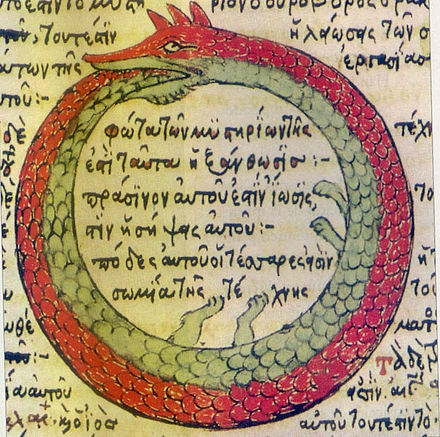
“…among the Jews and Christians, the ‘history’ apportioned to the universe is limited, and that the end of the world coincides with the destruction of sinners, the resurrection of the dead, and the victory of eternity over time…this doctrine becomes increasingly popular during…the early centuries of our era…Christianity translates the periodic regeneration of the world into a regeneration of the human individual.” The concept in the West, pre-Nietzsche, mostly returned to its esoteric roots, leaving little but symbols such as the Ouroboros as the outward representation of eternal recurrence. The Ouroborus, a depiction of a snake or serpent eating its own tail, first appeared in Egypt but became a symbol of the occult and alchemy in the West and is often associated with the concept of eternal recurrence.
In the East the concept of cycles and periodicity, creations and destructions was well developed in Indian/Hindu thought and the religions that emerged from Hinduism. A yuga represents the smallest unit of a cycle, “a complete cycle, or Mahāyuga, is composed of four ages of unequal duration, the longest appearing at the beginning of the cycle…” The first Krta Yuga, followed by Tretā Yuga, followed by Dvāpara Yuga and Kali Yuga being the last, all adding up to a cycle of 12,000 years. There is a progressive decrease in the duration of each yuga and a corresponding decrease in the length of human life as well as a general decline in the quality of human existence. We today are in a Kali Yuga, which is the end of a cycle and is to be terminated by dissolution. From this basic cycle, there is a longer cycle made up of 360 Mahāyuga or 4,320,000 years. A thousand Mahāyuga make up a Kalpa and fourteen Kalpa make a Manvantāra. A day in the life of Brahmā is one Kalpa, another Kalpa equals a night. However, there is no calculated end, so the successions of creations and dissolutions are endless. The finite, defined cycles of time in the Hindu tradition exist within an eternal universe of ordered, never-ending creation and destruction. The cycle of eternal creation and destruction can be seen in Hindu art such as the Nataraja, a depiction of Shiva as the Lord of dance, dancing within a circle of flames. Life, including human life, exists on the wheel of life called Samsāra, a cycle of successive existence with an endless repetition of incarnations in which beings are essentially trapped. The incarnations are not of the same because a being’s karma affects the form and substance of each incarnation. And liberation from Samsāra is possible, but only when one is incarnated in human form. The state of liberation from Samsāra is called Nirvana in Buddism and Moksha in Hinduism. These ideas of cycles of time in various forms also spill into Jainism. All are similar in their cyclical nature but with differences in the details.
The Uspenskiian Version
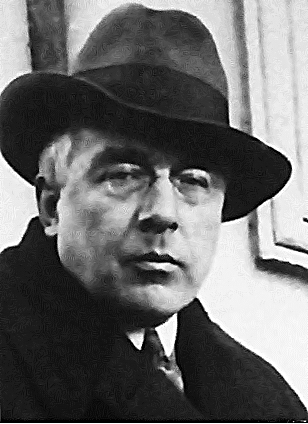
Though never stated, it seems probable that P. D. Uspenskii (1878-1947) was initially introduced to the idea of eternal recurrence of the same through exposure to Nietzsche. Uspenskii says he first came across Nietzsche when he was 16 and though Nietzsche’s works were at one time banned in Russia due to their anti-Christian character, a Russian translation of Thus Spake Zarathustra was first published in 1898, and this was followed by a decade of great interest in Nietzsche among the Russian intelligentsia. By 1912 nearly all, if not all, of Nietzsche’s works were available in Russian Translation. We know that Uspenskii was quite familiar with Nietzsche’s ideas. Tertian Organum published in 1912, includes a quote from Zarathustra (not related to eternal recurrence), while A New Model of the Universe, written mostly before 1914 but published in 1931, contains extensive references to Nietzsche’s work, Uspenskii even including a chapter on Superman, with extensive quotes and a generally favorable attitude toward Nietzsche’s work in this area. However, in the chapter on eternal recurrence he writes, “Nietzsche contributed a great deal to the popularization of the idea of eternal recurrence, but he has added nothing new to it. On the contrary, he introduced several wrong concepts into it, as for instance his calculation, which mathematically is altogether wrong, of the mathematical necessity for the repetition of identical worlds in the universe.” That said, regarding Nietzsche, Uspenskii goes on to state, “He felt the idea as a poet. And several passages in his Zarathustra, and in other books where he touches upon the idea, are perhaps the best he ever wrote.”
Uspenskii felt the idea was of Pythagorean origin or at least that Pythagoras likely taught it. He bases this specifically on the writings of Simplicius (490-540 AD). But Uspenskii took the basic idea of eternal recurrence and sought an explanation grounded both in science and metaphysics. In his book A New Model of the Universe, he traces the history of the idea in the West, from Pythagoras to Jesus to Tolstoy and beyond, yet he asks a rhetorical question, “Why did not people long ago come to the idea of eternal recurrence?” They, as he acknowledges, did but he felt that, “The usual view of time leaves no place for recurrence…eternal recurrence cannot be proved in the ordinary way…by the usual methods of observation and verification.” And that other ideas such as, “…theories of reincarnation and transmigration of souls…are actually only a distortion…” As well as similar ideas contained in “…occult teachings…changing the past…the cult of ancestors…[these] are connected with the idea of recurrence.”
As one looks at Uspenskii’s ideas on eternal recurrence, there is some differentiation in both tone and substance in what is presented in New Model, and what was recorded in three other books that are essentially records of his meetings and lectures as a teacher of his version of The Fourth Way. As one reads New Model, it comes across as both a teaching and an exploration. Though the basic sense and theory of what is presented in all the books is quite similar, in the records of meetings and lectures, eternal recurrence is less a teaching and more an exploration and there is often given the caveat that this is all theoretical and not a part of what Uspenskii called “the system.” Nevertheless, the sense is that in Uspenskii’s mind, it was clearly a theory he believed in. The meetings/lectures with questions and answers documented in The Fourth Way, A Record of Meetings and A Further Record often bring the theory down to a more human, less general, more practical and typically less dogmatic level. Additionally, we also have the Uspenskii authored novel, The Strange Life of Ivan Osokin in which he creates a story (in part autobiographical) centered around eternal recurrence and the trap that all humans, even those with some degree of awareness of their predicament, find themselves in. Taken together, this Uspenskii material provides, by far, the most detailed exploration of workings of eternal recurrence that is available. Beginning with a look at what is in New Model, we see Uspenskii’s theory of recurrence is tied into his ideas regarding time and dimensions.
Unlike Nietzsche, Uspenskii, in exploring the functioning of eternal recurrence was willing to posit ideas that were beyond the current scientific understandings of his day. Fundamental to his explanation is the statement, “Life in itself is time for man. For man there is not and cannot be any other time outside the time of his life. Man is his life. His life is his time.” This is in some way similar and not opposed to Gurdjieff’s statement in the First Series that time is the “Ideally-Unique-Subjective-Phenomenon.” Uspenskii says, “The idea of time as the fourth dimension does not contradict the ordinary views of life, so long as we take time as a straight line…but the idea of time as a curve of the fourth dimension entirely changes our conception of life…when we begin to see how the curve of the fourth dimension is transformed into the curves of the fifth and sixth dimensions, our views…cannot remain any longer what they were.” Taken simply, he explains, “The fourth dimension is the realization of one possibility of each moment…The fifth dimension is the repetition of this. The sixth dimension is the realization of different possibilities…difficult to think about this so long as we think of time as a straight line.” Here, we see Uspenskii exploring hypothesis well beyond the science his day.
As he says, “The idea of recurrence may have many quite obvious faults, but mathematically it is right and is certainly better than any other idea of this nature, because otherwise, without the idea of recurrence, there would be no past. If there is no past, there is no present…if we travel by train we cannot expect all the stations we pass to disappear, and those to which we come to be built anew…” The essential problem with coming to an individual understanding of recurrence is the limitation of the ordinary mind. “…by imagining ourselves in a three-dimensional world, we make this world non-existent…if we take, for instance, the ordinary view of the past disappearing and the future not yet existent, then nothing exists…either nothing exists or everything exists—there is no third alternative…” Uspenskii says that recurrence cannot be visualized with our ordinary mind, the lower centers, though this is possible with our higher centers. But that first we must develop and use our lower centers to their fullest extent rather than simply their mechanical parts.
Recurrence is Neither Eternal nor the Same
Uspenskii’s writings and his recorded answers are a somewhat scattershot exploration of the issue. Presented as fact, theory, hypothesis and philosophy he goes where no one else goes. In New Model and elsewhere he takes recurrence, regarding men, away from both the eternal and the same. Recurrence is mechanical and the more mechanical an individual man, the more mechanical recurrence will be for such individuals; thus, he believes that the type of recurrence varies for different people.
- “…people of absolute repetition,” no variation.
- “…people …have each time the same beginning, but… with slight variations…the same end.”
- “…people …with a definitely ascending tendency…outwardly.”
- “…people whose lives…display a clearly marked descending line…reduces them to nothing.”
- “…people whose life contains an inner ascending line, which gradually leads them out …of eternal repetition…to another plane of being.”
Regarding inner growth, inner development, that is, a real evolution of consciousness, Uspenskii says that “it cannot be either accidental or mechanical.” Accordingly, of the above; types 3 and 4 have no chance to evolve and for 1 and 2, it is possible but very difficult. These 4 categories make up the great majority of human beings. Where or how Uspenskii came to this is unclear and unstated.
Uspenskii says, “Evolution for all categories of people is connected with recollections…evolution means escaping from the wheel of the fifth dimension and passing to the spiral of the sixth dimension… recollection has importance…when it creates discontent with what exists and a longing for new ways.” So why don’t we remember our past lives? If there is recurrence, we may have lived a same or similar life hundreds or thousands of times. There are several ways of looking at this question. One is that at times we indeed do remember what has happened, but it seems a subtle remembrance and is not held in ordinary memory. It may tell us what we must do or should do. Many people experience this, either following what they somehow know should be done or not doing so (while somehow knowing the outcome) and experiencing regret at not doing so. We call it intuition, or instinct, we know just what must be done or what will happen, not intellectually by memory but another function operating in the background of waking consciousness. This creates fatalism in certain people, particularly those of an absolute repetition. It is often quite difficult to separate what these subtle remembrances are from imagination and simply a knowing of the mechanics of how life and people usually work.
Uspenskii believed the study of eternal recurrence must begin with the study of children. He says that “…all acquired tendencies are supposed to repeat themselves.” He notes that it is fairly common to see unusual tendencies appear in children that cannot be attributed to either heredity or the environment in which they are growing and living, “…parents do not understand their children and children do not understand their parents…They are quite different people—strangers to one another; they just happened to meet accidentally…” Uspenskii says this investigation must start with “…the study of children’s minds, and particularly before they begin to speak. If they could remember this time they could remember very interesting things…when they begin to speak they become real children and they forget…If they remember their mentality it is the same mentality as grown up people have.” While there may well be something to what he suggests from a practical standpoint this study would seem to be nearly, if not completely impossible. In fact, this aspect of his exploration seems quite muddled. He states that, “Some people I knew had very interesting recollections of the first years of life…that the [their] mentality was not a child’s mentality.” Asked why it disappears he says, “It begins to imitate children and do exactly what grown-up people expect …they expect him to be a stupid child and he becomes a stupid child.”
This statement seems a simplistic and implausible explanation. Perhaps better to just say, I don’t know why, which to his credit Uspenskii often does, though not here. While it seems right that in the early months of life, in many children there is not a blank slate being filled by the new impressions of life, Uspenskii seems to be grasping. Another thing he speaks of is tendencies in children, that is, unexpected tendencies which he feels are or can be carried over from past recurrences, becoming stronger with each recurrence. “…quite unexpected tendencies can appear in quite young children, and not accidental tendencies that appear and disappear. They will continue throughout life afterwards.” This idea has resonance, but is simply an idea coming from observation without much to back it up and this, as Uspenskii admits at times, is all theory, yet a quite interesting concept.
Maurice Nicoll, a noted psychologist who studied with Jung, was a primary student of Uspenskii. He also spent about a year at Gurdjieff’s Institute at the Prieuré (before Uspenskii and Gurdjieff had ended their relationship) and was unique in being given leave, by Uspenskii, to teach what was essentially Uspenskii’s version of the system, though also directly influenced by Gurdjieff with some of his own insights including many biblical references. Regarding eternal recurrence, he generally recapitulates Uspenskii but does explore the idea of memory in a somewhat unique way. He says there are different kinds of memory, “…memory is our relationship to the 4th dimension…Underlying our personal memory there is a deeper memory…” What Nicoll calls personal memory could also be called formatory memory. It is fragmented, fading and imperfect. It is subject to the interpretation of the human personality through which it is usually presented. The deeper memory, which Gurdjieff also writes of in the First Series as being able to be accessed through his method of hypnotism, is potentially a perfect record. How to access?
Nicoll also records some experiments with the use of drugs by Sir William Ramsay, a Nobel Prize winning chemist, in the late 1800’s. Ramsay used anesthesia to come to a state of heightened consciousness that was neither the waking state nor the unconscious state or sleep state. Taking modulated doses of ether, he reports, “Everything has occurred before…sense of having been here before…Every bit of these events recurred—except fact of woman instead of man as observer…” So not an exact recurrence or not an exact memory of the recurrence, but apparently the state induced by the ether allowed the deep memory to be accessed. As noted by Nicoll, Ramsey saw many things, but under the influence of drugs they seem very fragmented. Clearly, something was opened, but as often happens, the ordinary mind interprets what is awared in a drug-induced state often giving the experience some degree of lost objectivity.
Escaping Recurrence
When speaking of those who fall into category 5, that is, those “…whose life contains an inner ascending line…,” Uspenskii, certainly for those in the Work or other legitimate ways, provides us with a unique and interesting exploration. To begin with, Uspenskii states that his specific work has not occurred before and there is no guarantee it will recur. Recurrence is mechanical and a real school is from a conscious influence, what in the Fourth Way is called C influence, and therefore not subject to mechanical recurrence. Schools may recur in a different form or in the same form in a different time. A person may or may not reestablish contact or they may find a new school or no school at all. He says that mechanical people can recur almost forever, though nothing is truly eternal. However, “… if people become more conscious…their time becomes limited…in the work, in relation to one life, time is counted…and the more seriously they work, the more strictly is their time is counted…the same principle can be applied to recurrence.” Further, regarding people that are in complete sleep, they simply recur because, “For one who has not begun to awake, time is not counted because it does not exist.” And theoretically according to Uspenskii, everyone is “reborn” in the exact same time—this cannot be changed. And again, speaking theoretically regarding the Work, people will re-begin where they left off in the previous recurrence, assuming they truly came to something. Essence or something of essence is that which recurs, essence is where memory is carried, while personality, including the magnetic center, disintegrates at the death of the physical body. Given we are born into the same general life and circumstances, the same external experiences that formed the personality and magnetic center may well be present in subsequent recurrences, causing the development of a quite similar personality. The key to remembering past recurrences is self-remembering in this recurrence for if we sleep through this life, there is no substantial memory formed to even give the possibility of remembering in the following recurrence. But if we truly come to something, it is not wasted for “…only man No. 5 can recur as man No. 5. He may not know it, but things will be easier for him. No. 4 has to make again, only it will be easier and earlier.”
Is there an injustice felt because of the consequence that as one works to evolve, there are fewer and fewer recurrences within which to come to a level of being which is outside of mechanical recurrence? It may seem unfair that people completely asleep may recur almost indefinitely, while a person drawn to evolve has an unknown but limited number of recurrences. But as Uspenskii says, “if man remains mechanical, he can recur ten thousand times and will not profit by it…But if one begins to work, it [recurrence] becomes enormous…but by itself ten thousand lives or one life are just the same.”
A Further Look at Counted Time
Is there another way to view the idea that “time is counted” when one enters a Work? On a functional and individual level, this idea was not really fleshed out by Uspenskii. Often this statement is taken in an ordinary way, as some sort of countdown to oblivion. Is that really the case? Functionally speaking, it seems time would be counted when one comes to a certain level of an astral, or as Gurdjieff calls it, a Kesdjan body. That is a body capable of existing consciously in the fourth dimension while contacting the fifth dimension, worlds 24 and 12. More to the point, it is creating a body capable of establishing a connection with the higher emotional center. Why would this matter? Once a substantive Kesdjan body is acquired, its basic functionality can, and almost certainly will, alter an individual’s life circle of time and therefore alter its physical recurrence. One of the features of the higher emotional center is said to be some level of what is called clairvoyance, but is it more correctly a contact with what Nicoll calls a deeper memory, potentially a memory of the circle of our entire life? Given our linear view, this appears to the ordinary mind as if there is a knowing of the future. Typically, this function is not available to the ordinary mind, though there could be moments when the higher emotional center may be connected and we have a flash of knowing/seeing what we call the future. But oddly, might this not be a direct knowing of the past, that is, a previous recurrence? This is well beyond the level of what is called déjà vu, which would seem to be merely an associative, emotional remembering in the lower centers. In ordinary people, often in a very small way, this may happen and is commonly called intuition, a gut feeling; yet the mere knowing, even semi-consciously, could potentially change the circle of time within which a physical body is recurring—and if it is heeded—perhaps change a recurrence in a significant way. In more developed people working at the deeper levels of self-remembering, this knowing may well become a conscious doing by which changes in the mechanical circle of recurrence more significantly occur. So, there are many different degrees and levels of what is essentially a doing otherwise, that as we move from the mechanically induced psychological sleep locked in the circle of ordinary recurring human existence to the third state of consciousness with the concurrent development of a Kesdjan body and access through it to the higher emotional center, its seeingness could alter an individual’s mechanical recurrence.
And Then What?
Once we relatively and perhaps only momentarily step out of our circle of time (as Uspenskii says, a man’s life is his time), altering the mechanical recurrence of the physical body from what was its recurrent pattern, we for better or worse could create a new pattern of recurrence and an altered time, which is then taken as being counted. It seems possible that even an accidental, flash activation could be potentially significant. Are these moments crossroads in our lives? Uspenskii says we are reborn to the same parents, and the date of birth is always the same but nothing else is absolutely fixed; therefore, our recurring life may be altered by a knowing that creates a doing, that then alters mechanical recurrence. The alteration of each succeeding recurrence may so change our life that at a certain point we move out of our original mechanical recurrence and each succeeding recurrence has little resemblance to the last. Thus the duration, number and experience of our recurrences could be significantly altered. Deep memory would be of less use in an ever-changing recurrence. Does fate or accident then limit or affect our lives? Does an ever-different circle of time exist in a bubble protected from outside forces? Is our development strong enough that we then gain control over recurrence, or could we lose the physical body at a point on the circle where we have not yet acquired a level of development that can control recurrence and thus be left in some state of purgatory? Is this what Gurdjieff was referring to regarding the life of incompletely developed beings on the Holy Planet Purgatory in the First Series? Perhaps this is the expectation for all “higher-being-bodies.”While many of these questions are unanswerable, ultimately it is to acquire a soul which has an existence completely outside of time and recurrence—in the sixth dimension—and is therefore immortal within the limits of the solar system.
Uspenskii, throughout his life, was very much taken with the idea of and belief in recurrence and with preparing for his next recurrence. And as was stated, he developed this idea far beyond others. His taking of the idea from the conceptual, philosophical and cosmological to the human level was unprecedented and remains so. Yes, Nietzsche poetically speaks to the human issues but only in a general manner. About a month before Uspenskii died, he was prepared to take a ship back to America. His luggage already on board, he tells his student, Rodney Collin, to get his luggage off the ship, “I am not going to America this time.” [Emphasis added.] Further, in the next few weeks, quite ill with kidney failure, he is driven around England to try to impress various locations that had been a part of his life into his memory for his next recurrence.
Science
While current science does not deal with recurrence on a human level, it has and continues to look at the origins, function and fate of the universe as a whole. “Virtually every cosmological model…falls into one of three categories. The… ‘created universe,’…‘unchanging universe,’…And the… ‘episodic universe’…At most periods of history …all three categories were being discussed and debated…” Essentially, since the discovery of microwave background radiation or CMB in the 1960’s, the created universe has become the consensus theory. That is a universe that “sprang into existence” at a finite point in time and has evolved since. Current scientific agreement is that the universe as we know and ordinarily experience it, that is, a universe of three dimensions, began with what is called “the big bang.” Generally thought to be a micro-second eruption/expansion of matter and energy, a hot primordial gas exploded from “something” roughly 14 billion years ago. This has essentially inflated the nothingness with energy. Accordingly, the universe has been expanding or inflating while cooling since that moment. The cooling and slowing have condensed some of the gas into galaxies of stars, planets and other features; the expansion of the universe slows due to the attractive force of matter and radiation (gravity). The thinking is that the moment of the “bang” is when time, that is, a linear time, began. And if it has a beginning, will it have an ending? There are many theories regarding the fate of the universe. Currently, perhaps the most accepted theory suggests an expanding yet decelerating universe that decelerates without end, though this is neither proven nor universally accepted. This is a universe that cools as it decelerates; it may, under another theory, cool to a state of entropy near absolute zero. Or it is also theorized that at some point the force from the initial “bang” may wane and the universe then will begin to contract due to gravitational forces, in what has been labeled “the big crunch.” These theories are among many regarding the fate of the universe. An issue for proponents of the big bang is that it started from a “something” and science has no idea what that something would be and/or why it started, or if there is a why.
Einstein originally believed in a static, unchanging universe. When Edwin Hubble determined that galaxies were spreading apart and that the universe was expanding, Einstein had to abandon the static model, and admit a blunder.
The episodic universe model is the theorized model that eternal recurrence best fits, “…with repeating epochs of creation, evolution, and dissolution, where repetitions may be regular or irregular.” This model, as we have explored, was at times the accepted model but had been essentially abandoned until relatively recently. Interestingly, after Einstein abandoned the static model, he initially leaned toward the episodic model; however, mistaken mathematical calculations caused him to move toward the created model. The episodic model in its early 20th century iteration was called the oscillating universe and postulated a series of equal loops, or oscillations, of universe expansion and contraction along a linear path of time. This model had many flaws and was also mostly abandoned. In the1990’s, several scientists began work again on a modified version of the episodic universe. Armed with new data, they began to develop a cyclic model that was based on string and M theory. In the new cyclic model the big bang was not, “… the beginning of time but rather a violent transition between two stages of cosmic evolution, with a ‘before’ and an ‘after.’” The new complex theory is based on a multi-dimensional universe where the dimensions are separated by “membranes” called branes and the expansion/contraction is determined by the effects of dark energy on the system. There is no beginning and no end as the universe cycles from big bang to big bang caused by the relationship of the branes of various dimensions. The originators of the theory decided to call it an ekpyrotic universe as it appears to be a much complexified version of the Stoics’ concept of ekpyrosis. This cyclic model is the nearest current scientific model to a universe based on recurrence.
Science is examining the mechanics looking for a unified theory, but as data is received, theories are often invented to rationalize the data. Once a theory is formulated, it is changed or abandoned based on what new data is received. Science sees an expanding universe and can only see the ongoing expansion, not what came before the expansion began, or even if there was a before the big bang. The cyclic model marginalizes this issue, and that is part of its appeal. Regardless, it is still an essentially truncated and segmented view, as well as an ever-changing view attempting to come to unity from fractured pieces of data which tend to generate a partial, potentially faulty and moving view of the universe. This piecemeal view begins as observational and empirical, the knowledge derived though the ordinary imperfect faculties of man that have been magnified with instruments that are more sensitive than the ordinary senses—computers, telescopes, radio astronomy, particle accelerators and so forth. Ultimately, the data is still processed by the intellectual center, and though highly functional, it is still the lower intellectual center, and therefore incapable of objectivity and of truly understanding the scope and scale of what it is exploring.
The Stoics and many others as mentioned earlier felt the universe/world ended in a conflagration only to be reborn. Fire was seen primarily as a destructive force in those times, but of course fire is also a source of light, heat, processing of food and indirectly, through the photosynthetic process, the source of and base for most life on Earth. It was also seen as a cleansing and regenerative force as from the ash of a fire grew the greenest plants replacing what was destroyed in a natural recurrence. In the “big bang” it is a creative force as the release of energy creates and grows/inflates the universe. On a certain level, this is not in opposition to Fourth Way teaching. However, a question to be considered is to which universe/ cosmos/world the current scientific theories apply? Certainly, most work is related to the visible universe. From a Fourth Way perspective, the universe is viewed as a multiple interpenetrating cosmos of varying density and vibration. Gurdjieff says all laws can be understood by the study of three adjoining cosmos. The Micro, Trito and Meso cosmos are the most accessible to ordinary scientific exploration. But generally, science does not explore these as complete cosmoses but as parts of a singular, visible (often only through magnification) universe, a three-dimensional universe in which man’s physical body exists. A fourth dimension is considered and accepted to be space-time, that is, the three ordinary dimensions in time. The planetary world, space, suns and so forth, are also seen from this perspective, as are the atomic and subatomic worlds of electrons, protons, neutrons, quarks, bosons, and so on. Everything weighed and measured to the extent it can be with the assumption that what we are perceiving from in the case of distant galaxies thousands of light years away is the same as our three and occasionally four-dimensional view. Other dimensions are considered theoretically possible and form vital aspects of certain ideas/hypothesis, such as string theory. There is no consideration that the stars and planets we see are multi-dimensional beings of which we can only barely begin to know through our instruments of scientific observation. Uspenskii states, “…we represent the earth to ourselves as three-dimensional…this three-dimensionality is only imaginary…Our view of it is incomplete, we see it as a section of a section of a section of its complete being. The ‘earthly globe’ is an imaginary body. It is the section of a section of a section of the six-dimensional earth.”
Breath is Time
Two scientists, Paul Steinhardt and Neil Turok, who originated the “new” theory of an ekpyrotic universe or cyclic theory write, “In the old approach [the created universe], the usual three dimensions expand and contract as if the universe were breathing in and breathing out…In the new cyclic model, the usual three dimensions expand from one big bang to the next. The breathing in and out is done by the extra dimension…” According to Gurdjieff, there are seven cosmoses. He says, “Each cosmos is a living being which lives, breathes, thinks, feels, is born and dies.” Are they then born again? Perhaps so, as “All cosmoses result from the action of the same forces and the same laws. Laws are the same everywhere.” If recurrence occurs in the tritocosmos (man) will it therefore occur in the megalocomos (all worlds) as well as the other cosmoses? There arises the question of relativity and scale, which Gurdjieff says between two cosmoses is that of zero to infinity. Given the capacity and function of the ordinary mind, there is a limit to what can be understood. Uspenskii attempts to quantify the scale of time between the various cosmoses in his table in Search from Gurdjieff’s postulate that “breath is time.” He takes three seconds as a breath of the tritocosmos and extrapolates the duration of an impression, breath, day and night and life of each cosmos. Though modifying Gurdjieff’s “zero to infinity” to projected calculations of duration based a breath, the 24-hour day, the average life for man, and so forth, Uspenskii in this way, makes scale and relativity more accessible to the ordinary mind.
Culture
There is little doubt that the idea of eternal recurrence has, to a degree, penetrated the philosophic underpinnings and culture of the West, though mostly in an indirect way. One does not typically associate Shakespeare with recurrence and yet, in his musings on questions of time, his writing has the unmistakable flavor and feel of recurrence particularly in Sonnet 59:
“If there be nothing new, but that which is
Hath been before, how are our brains beguiled,
Which, labouring for invention, bear amiss
The second burden of a former child!
O that record could with a backward look
Even of five hundred courses of the sun
Show me your image in some antique book…”
William Shakespeare
The idea of recurrence has also entered other literary works. We have examples of philosophers using the form of a novel to explore the idea, there being Uspenskii’s novel Ivan Osokin, whilethe Swedish philosopher Søren Kierkegaard’s book, Repetition, a somewhat philosophical and farcical “novel” written in 1843, explores a form of this idea. Did Kierkegaard’s book have some influence on Uspenskii? There is some resonance between the two books, though more in form than substance. Kierkegaard in the supplement to Repetition writes, “Thus there is repetition in the phenomena of nature and in the phenomena of the spirit… the repetition of our errors and of our virtues…the question is merely how would the individual learn to become sensitive to this repetition.” We also have novelists using the philosophical idea of recurrence in their novels. We find many works of fiction contain elements of eternal recurrence including: Dostoyevsky, James Joyce’s Ulysses and Finnegan’s Wake, and more modern works such as Cloud Atlas by David Mitchell. Dostoyevsky writes in The Brothers Karamazov:
“…But our present earth may have been repeated a billion times…and the same sequence may have been repeated endlessly and exactly the same to every detail. Most unseemly and insufferably tedious.”
Fyodor Dostoyevsky
As to the genre of science fiction where it seems traversing time, both forward and backward, is a phenomenon that “recurs” endlessly, the past is still there and the future has already occurred. Though the philosophical basis is rarely, if ever, explored, these ideas have become so woven into the culture as “possibilities” that they are not considered as strange concepts but a routine part of science fiction works. This fictional portrayal is reflected in video games, TV programs and the general societal acceptance that “time travel” may someday be possible. Some of the most vivid representations of recurrence, partial in nature, are given in the film medium. The most commonly thought of and highly viewed recurrence-related film being Groundhog Day. The film is classified as a fantasy-comedy. Bill Murray did not write the screen play but was the lead actor in the film and has been involved with the Gurdjieff Work. The version of recurrence given has Murray caught in a day-after-day time loop, until he begins to do otherwise. This appears to be an appropriation and modification of Uspenskii’s ideas rather than Nietzsche’s, blended into a story suitable for Hollywood. More recently, there has been an adaptation of the film for the stage. In the film Edge of Tomorrow the lead, Tom Cruise, uses recurrence and remembering to ultimately defeat an aggressive alien presence on earth. In Déjà vu, a machine created for another purpose allows the looking into the past but only exactly 4-1/2 days in the past. There is some quasi-scientific blubbering about folded space and an Einstein-Rosen bridge, aka, a wormhole. The lead actor, Denzel Washington, transports himself back to thwart a terrorist attack that has already occurred—on many levels this movie is rather muddled. On the other hand, the film Arrival provides a more subtle and nuanced exploration of recurrence in the context of, this time, a friendly visit of an alien species. The current Netflix series Russian Doll is more in the vein of Ground Hog Day. By using a blur of ideas related to recurrence the writers provide an entertaining, engaging comedic drama framed by recurring death and rebirth.
While science dances around the edges of cyclical time, the idea of recurrence has gradually moved into Western culture as a fictional and/or fantastical idea, essentially a titillating, corrupted version. Recurrence is not a mainstream idea regarding either the nature of time or of life and death, and perhaps never will be. The idea goes against the mechanical, linear view of life and time that modern man is locked into. To most people it seems absurd and what people call a Nietzschean “thought experiment,” rather than a possible explanation to profound universal questions. Compounding this, in the dominant Western religion, Christianity, as well as Islam, as they are generally practiced, the concept of recurrence is not accepted. There is the promise of an eternal existence, though not a recurring existence, but rather an eternity in some Heaven or Hell after one go-round on Earth. Oddly, the idea of a single life followed by a super-natural after-life fits many peoples’ sense of the possible better than the idea of recurrence, perhaps because it happens within a context of continuous time. In the Buddhist and Hindu teachings reincarnation is a foundational belief. Reincarnation in its various forms, perhaps derived from recurrence, is seen generally in more acceptable linear terms. In these Eastern teachings, human time of death and reincarnation feels linear as the wheel of life rolls along, death and rebirth occurs in continuous time, while world time is cyclical.
Gurdjieff, in the record we have, aside from his conversation with Uspenkii recorded in Search, only mentions recurrence twice, and briefly so. In his conversation with Uspenskii he says, “What is the use of a man knowing about recurrence if he is not conscious of it and if he himself does not change?” In this Uspenskii would agree. Further, Gurdjieff says, “If you tell him about repetition, it will only increase his sleep. Why should he make any efforts…Why should he bother today? But importantly he also adds, “…if he changes something essential in himself…this cannot be lost.” But Uspenskii had a fixation, a demand and an aim. Speaking in Russia he says, “I formulated my aim several years ago…a man can know, and has a right to know, exactly how much time is left to him, how much time he has at his disposal…he can and has the right to know the day and hour of his death. I always thought it humiliating for a man to live without knowing this…For what is the good of beginning…work when one doesn’t know whether one will have time to finish it…” Uspenskii never wavered in the aim of knowing when his present recurrence would end, and quite likely achieved it.
—Richard Myers— http://www.growing choongary.com
Notes
1. Tell me what you think of recurrence. P.D. Ouspensky, In Search of the Miraculous (New York: Harcourt Brace, 1949), 250.
2. The thought of eternal return. Martin Heidegger, Nietzsche, Vol II: Eternal Recurrence of the Same (HarperSanFrancisco, 1984), 12-13.
3. Nietzsche’s philosophy. Karl Löwith, Nietzsches Philosphy of the Eternal Recurrence of the Same, trans. J. Harvey Lomax (University of California Press, 1997), 11.
4. The Greatest Weight. Friedrich Nietzsche, The Gay Science, trans. Walter Kaufman (New York: Random House, 1974), 273-74.
5. I am weary of my wisdom. Friedrich Nietzsche, Thus Spake Zarathustra (New York: Dover Publications, 1999), 1.
6. After Buddha was dead. Nietzsche, Gay Science, 167.
7. I teach you the Superman. Nietzsche, Zarathustra, 3. The superman—what did Nietzsche mean when he spoke of the superman, the ubermensch? He never really defines the superman, other than what it is not. It is not an other-worldly man nor a successful man of the world dominating others with his power. The literal meaning of the German ubermensch is over man. This seems very different than superman, or at least as what a superman has come to be thought of today. Does the overman overcome himself, that is, overcome his person to come to a deeper, pure experience of life? In the context of eternal recurrence, does the overman will his recurrence? And if so, eventually change the course of his recurrence? The idea of altering one’s recurrence is not spoken of as a possibility by Nietzsche, but attaining control over one’s person could be a step toward that.
8. Zarathustra’s fate. Nietzsche, Zarathustra, 155-56.
9. The teaching of eternal recurrence. Löwith, Nietzsche’s Philosophy, 94.
10. Justification of the eternal recurrence. Löwith, Nietzsche’s Philosophy, 94.
11. Nietzsche’s positivist explanation of recurrence. Löwith, Nietzsche’s Philosophy, 91.
12. In infinite time. Löwith, Nietzsche’s Philosophy, 90. The book Will to Power was assembled after Nietzsche died by his sister Elisabeth and Nietzsche’s friend Peter Gast (Johann Heinrich Köselitz). It was assembled to try to form a coherent philosophical system as Elisabeth, who would later become an admirer of Hitler, saw it as a chance to publish the magnum opus she felt her brother never completed. Compiled from his unpublished writings and notebooks, it is to be regarded with at least serious skepticism. Nietzsche’s reputation as a hero to the Nazis and in general a militarist originates primarily from this book and other random ideas plucked from his works, often taken out of context. Martin Heidegger felt it represented the core of Nietzsche’s philosophy, most current scholars disagree. As to regarding his work as a philosophic base for what was to become National Socialism, while some Nazis tried to make much of the ubermensch, welding it into their concept of the Aryan master race as well as some of his other ideas such as a will to power being the driving force of man’s evolution, the general concept of Nietzsche as a Nazi is really quite absurd. As one forthcoming Nazi said of Nietzsche, while he was not a nationalist, not a socialist and not an anti-Semite, leaving all that aside, he would have made a fine Nazi. Uspenskii felt Nietzsche was misunderstood and In New Model he quotes from Zarathustra as a rebuttal to the claim that Nietzsche was responsible for, or at least provided a rationale for, German militarism and chauvinism.
13. Sidetracked in physics. Heidegger, Nietzsche, 107-08.
14. Still a metaphysical faith upon which our faith in science rests. Nietzsche, Gay Science, 282-83.
15. I have sought in vain for signs. Friedrich Nietzsche, Ecco Homo, trans. R. J. Hollingdale (London: Penguin Classics, 2004) 51.
16. The idea of periodic destruction. Mircea Eliade, The Myth of the Eternal Return or, Cosmos and History, trans. Willard R. Trask (Princeton, NJ: Princeton University Press, 1991) 87.
17. The periodic regeneration. Eliade, The Myth of Eternal Return, 129.
18. A complete cycle. Eliade, The Myth of Eternal Return, 113.
19. Nietzsche contributed. P. D. Ouspensky, A New Model of the Universe (New York: Alfred A. Knopf, 1961), 409-10.
20. The usual view of time. Ouspensky, New Model, 420.
21. Ideally-Unique-Subjective-Phenomenon. G. I. Gurdjieff, All and Everything, First Series, 124.
22. The idea of time as the fourth dimension. Ouspensky, New Model, 415.
23. The realization of one possibility of each moment. P. D. Ouspensky, A Record of Meetings Between 1930 and 1947 (London: Arkana/Penguin Books, 1992), 299.
24. The idea of recurrence may have many quite obvious faults. P. D. Ouspensky, The Fourth Way (New York: Random House, 1971), 426-27.
25. Type of recurrence varies. Ouspensky, New Model, 421-22.
26. Parents do not understand their children. Ouspensky, Fourth Way, 428.
27. Quite unexpected tendencies. P. D. Ouspensky, A Further Record, Extracts from Meetings 1928-1945 (London: Arkana/Routledge & Kegan Paul, 1987), 1-3.
28. Memory is our relationship. Maurice Nicoll, Psychological Commentaries on the Teaching of Gurdjieff &Ouspensky, Vol Two (Boulder, CO: Shambhala, 1984), 421.
29. Everything has occurred before. Maurice Nicoll, Living Time and the Integration of Life (Utrecht, Netherlands: Eureka Editions, 1998), 169.
30. If people become more conscious. Ouspensky, A Further Record, 13-16.
31. Only man No. 5 can recur as man No. 5. Ouspensky, A Further Record, 5.
32. If man remains mechanical. Ouspensky, The Fourth Way, 436.
33. I am not going to America this time. William Patrick Patterson, George Ivanovitch Gurdjieff: The Man, The Teaching, His Mission (Fairfax, CA: Arete Communications, 2014), 429.
34. Virtually every cosmological model. Paul J. Steinhardt and Neil Turok, Endless Universe: Beyond the Big Bang (New York: Doubleday, 2007) 168.
35. The big bang. Steinhardt and Turok, Endless Universe, 38.
36. We represent the earth to ourselves as three-dimensional. Ouspensky, Search, 212.
37. In the old approach. Steinhardt and Turok, Endless Universe, 186.
38 Each cosmos is a living being. Ouspensky, Search, 206.
39. If there be nothing new. Ned Lukacher, Time-Fetishes: The Secret History of Eternal Recurrence (Durham, NC: Duke University Press, 1998), 57.
40. Thus there is repetition. Søren Kierkegaard, Fear and Trembling: Repetition, ed./trans. Howard V. Hong and Edna H. Hong (Princeton, NJ: Princeton University Press, 1983), 290.
41. But our present earth may have been repeated. Fyodor Dostoyevsky, The Brothers Karamazov, trans. Constance Garnett (New York: The Lowell Press, 2009 [Ebook 28054]), 835.
42. What is the use. Ouspensky, Search, 250.
43. I formulated my aim. Ouspensky, Search, 99-100
 Open to Openness