

What’s “Behind”?
The Loss of the Human Tail
What happened to man’s tail? Do current scientific theory and Mr. Gurdjieff’s First Series both agree that humans at one time had a tail and how we lost it? Yes and no. Gurdjieff gives no time frame for his statement, but as to the human tail he writes, “…at the base of their spinal column, at the root of their tail—which they also, at that time, still had….” Science is a bit more specific and sees that today’s human ancestors, dating to approximately 25 million years ago, had a tail and likely lived in trees. While primitive Homo sapiens, our direct ancestors, who date to about 300,000 years ago, did not and do not, with extremely rare exceptions possess anything other than a what is called a vestigial tail. So, the time line is both interesting and not particularly in sync. Additionally, neither are Gurdjieff’s ideas regarding the descent of man, to borrow a phrase from Charles Darwin, in sync with Darwinian thought or current evolutionary theory. But deeper, what is the significance from the view of transformation and evolution of consciousness of this area of the body?
Science and the human tail
In general, as noted above, science posits that man’s relatively distant ancestors lost their functional tails about 25 million years ago. Evolutionary biology gives three main possible modalities as to how the tail disappeared:
- Natural selection, which as defined by Charles Darwin (1809-1882) and others states that very small changes over long stretches of time and breeding cycles can result in incremental yet very significant changes that accumulate within species and can be seen as a contributing factor of the creation of new species. As Darwin in 1859 put it. “…can we doubt (remembering that many more individuals are born than can possibly survive) that individuals having any advantage, however slight, over others, would have the best chance of surviving and of procreating their kind? On the other hand, we may feel sure that any variation in the least degree injurious would be rigidly destroyed. This preservation of favorable variations and the rejection of injurious variations, I call Natural Selection.” But Darwin was not satisfied simply with this concept which was not entirely of his own conception and incomplete.
- Some years later, in 1871 in his book The Descent of Man, he uniquely came to the idea of Sexual Selection. Darwin had briefly, in Origin of the Species, outlined this idea, but he fully developed it in Descent. While natural selection could explain certain things, there were substantial holes in the theory. Darwin could not help but see this, as it was orchestrated to him not in the Galapagos but in his home country. The male peacock with its massive display of tail feathers could not be explained by natural selection. Indeed natural selection alone would likely oppose such unwieldly and functionally useless feathers. As was apparent to Darwin, these feathers were related to the attraction of a breeding partner. Darwin, being a male in a male dominated society, was not pleased that the male of the species was, in this case, subservient to the female whims. He wrote in an 1860 letter to botanist Asa Gray, “The sight of a feather in a peacock’s tail, whenever I gaze at it, makes me sick.” Darwin, a man of his times, was sick because a male (a bird in this instance) goes so far as risking death by making himself visible and vulnerable to predation all in service to the requirements of attracting a female. As Darwin wrote in Origin of the Species, “…we may feel sure that any variation in the least degree injurious would be rigidly destroyed.” Is this quite right? For it would certainly seem that dragging around a bunch of three to four-foot feathers would certainly fall in that category, and yet they were not destroyed but apparently had gained an advantage. Thus, Darwin came up with and developed the theory of sexual selection. Today both natural and sexual selection are seen as drivers of evolution.
- The other accepted method of evolution is mutation. Mutation is today considered the primary agent of evolution. Put simply, the fundamental carrier of characteristics that are manifested in living creatures are determined by their genetic makeup. Thus, any change in the genetic makeup can result in physical manifestations of a life form. Knowledge of DNA and its role in genetic determinism was unknown in Darwin’s day though such a mechanism was suspected. Mutations can be caused by several means: exposure to ionizing radiations, DNA copying mistakes during cellular division, exposure to various chemicals that have mutagenic properties and infection by viruses. Once an altered trait is established sexual selection and natural selection can cause the altered life form to spread and dominate, or conversely to disappear or become recessive within the species populations.
And then we see, Gurdjieff, being Gurdjieff, has proposed a fourth pathway as to the creation of certain new species, the species in question being “these apes.” And the question, which in the late 19th and early 20th century was both a scientific, as well as a social/religious question, was—did apes descend from man or man descend from apes? He notes that the question was, “…This time agitating chiefly those biped beings who bred there on the continent called America.” He is writing this in the context of what was called the Scopes Monkey Trial, which took place in July of 1925 in Tennessee. Gurdjieff writes that after the loss of the continent of Atlantis, some of the surviving humans were isolated on what is now called Africa and finding themselves in groups segregated by sex, they began to turn to “anti-natural means” of sexual activity. The segregated females, “… began to seek out and accustom beings of other forms of the given place to be their ‘partners.’” From these “partnerships” of three-brained human females and two-brained quadrupeds resulted apes. And out of this, “…there now exist a great many species of generations of ape-beings differing in exterior form…each…bears a very definite resemblance to…a two-brained quadruped being still existing there.” Gurdjieff does not say which quadruped bares this resemblance. And as with all things in the First Series this story can be taken on many levels. From what is known in genetic science today, which is vastly more than in Gurdjieff’s time, this story on a literal level is not possible; though Gurdjieff does say that this abnormal blending was only possible due to the unique conditions both physical and metaphysical that occurred after the Earth’s second transapalnian perturbation, the loss of the Atlantean continent.
So, the tail?
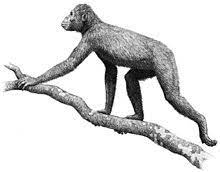
The fossil record currently names the first tailless ancestor of humans and great apes as a primate of the genus Proconsul. This odd name derives from a fossil found in Kenya in 1927 and named after a London vaudeville act of chimpanzees. Nonetheless, the 1927 find and others since are established to date from 23 to 14 million years ago. However, tail loss is thought to have occurred somewhat earlier when the lineage of humans and apes diverged from Old World monkeys some 25 million years ago. Current science hypothesizes that the tail loss was caused by genetic mutation. The gene in question is called the TBXT.
This gene gives instructions to make a protein named brachyury. “Brachyury is a member of a protein family called T-box proteins, which play critical roles during embryonic development. T-box proteins regulate the activity of other genes by attaching (binding) to specific regions of DNA… T-box proteins are called transcription factors. The brachyury protein is important for the development of the notochord, which is the precursor of the spinal column in the embryo. The notochord disappears before birth, but in a small percentage of individuals, some of its cells remain in the base of the skull or in the spine. The notochord helps control the development of the neural tube, which is a layer of cells that ultimately develops into the brain and spinal cord.”
The most recent study to begin to verify this hypothesis has been with mice. “The mutation…consisted of 300 genetic letters in the middle of the TBXT gene. This stretch of DNA was virtually identical in humans and apes, and was inserted in precisely the same place in their genomes.” Thus, there was evidence of a genetic commonality of tailessness among the tailless primates. To test the idea that the mutation was involved in the disappearance of the human tail, scientists engineered mice with the TBXT mutation. When these embryos developed, many of the animals failed to develop a tail while others only grew a short one.
So, what has been come to by science is a plausible mechanism, by mutation, of going from tailed too tailless. What is less understood is why this mutation spread widely. In fact, it is not really understood at all. For if we accept Darwin’s theory of natural and sexual selection, taillessness must be either or both an advantage to surviving in the primate’s environment or in having a sexual leg up, so to speak, on ones tailed competitors. If there were no advantage to being tailless it is probable the genetic mutation would have disappeared or become a recessive trait within the tail-bearing human ancestors.
It seems on the face of it that for animals that live in trees a tail, particularly a prehensile tail (grasping), would be of great value in living and navigating its environment. In watching current day monkeys moving through and living in the trees remarkably adapted and moving with agility and grace, it is almost implausible to think that tailless tree-living primates have much or any advantage in existing in such an environment, but nature provides few absolutes. And there are tailless primates, gibbons and orangutangs, that live in trees, both are fairly close relatives to humans. Gibbons share 96% of the human genome and orangutangs 97% and both are arboreal. Chimpanzees, which are both terrestrial and arboreal, are believed to be our closest living relative and have over 98% similar genome to humans. Did our primate ancestors lose the tail before or after leaving arboreal life? If we take the species Proconsul as a direct ancestor, then the losing the tail occurred while living in the trees and as a quadruped, as Proconsul had no tail.
Once we come down to earth, literally, things change. It seems quite plausible that for primates living mostly on the surface that a tail could be an impediment to survival (such as a predator grabbing it), or perhaps it was simply an unneeded vestigial adornment left over from arboreal life? But we also see tails have many uses in terrestrial animals from communication, to propping the body upright, like a third leg. One theory stated that when humans became bipedal, they no longer needed a tail. And it’s true that Homo sapiens is the only species of ape that is truly a biped. Yet, many apes can function as bipeds though their body types are designed for existence primarily as quadrupeds. There are many terrestrial tail-possessing animals, both bipedal and quadrupedal, including terrestrial primates, such as baboons. Baboons generally live on the earth’s surface and have tails. All and all it appears that there is not a vital survival need for a tail in humans (as witnessed by the fact there about 8 billion humans on the planet) there also appears to be no great advantage in the lack of a tail.
What about sex?
It is currently believed that the sexual component of natural selection based on sexual preferences, sometimes of the male, but mostly the female, is more important, as a means of evolution than Darwin’s generalized natural selection by enhanced mechanisms of survival. Given the time frame of millions of years ago, it is impossible to know if man’s mutated tailless primate ancestors were in some way advantaged sexually, but it seems a least possible that they were. In what we see in the animal world today adornment, in this case lack of or change of adornment, is a typical but not the only way by which males attract females and gain procreative advantage over their male competitors. Would a tailless male be more attractive to females of a Proconsul species living in African trees 20 million years ago? Or perhaps sexual attraction changed with the loss of the tail. Gurdjieff writes, “For three-brained beings of the male sex there, the ‘beard’ is the same as our tail is for us, which, as you already know, adds, to the beings of male sex among us, masculinity and activity.”

With modern primates (excepting current Homo sapiens), unlike lower animals such as birds, adornment appears to play little role in mating success. Rather size, aggressiveness and associated bodily weapons such as teeth and claws seem to be what keeps other males at bay while the females often passively await the male’s attention. The locus of the male (and female) animal remains in humans, centered in our lower story, instinctive/moving/sexual centers. These centers are at their base, mechanical levels, directing the biological survival of the individual human “animal” and Homo sapien species. In humans this is manifested in many ways not simply sexually. Religion and societies based on religious teachings, have imposed multiple reward/punishment barriers to unfettered actions of male/female animalistic sexual and other lower story actions. As to sex Gurdjieff says, “…sex plays a tremendous role in maintaining the mechanicalness of life… [however]When sex is clearly conscious of itself and does not cover itself up by anything else it is not the mechanicalness about which I am speaking. On the contrary sex which exists by itself and is not dependent on anything else is already a great achievement.” Would this level of sex be “natural”? That is at a real animal level unfettered by the constraints of a conventional morality imposed by religion and society? Or is Gurdjieff referring to something else?

And what would be human “natural” mating and sex resemble? This seems impossible to know. However, if we look at our closest living primate relatives the Chimpanzees, we might have a glimpse. Living in their natural habitats we see a society which functions in ways both similar and dissimilar to our own but likely much closer to early Homo sapiens in the forests and savannas of Africa several hundred thousand years ago. Chimpanzees live in socially complex communal extended yet fluid family groups. These are hunter gatherer societies organized much as early Homo sapiens are believed to have been organized. Chimpanzees live in groups of 20 to well over a hundred individuals. The society is generally patriarchal and there exists a male hierarchy were in the alpha males have better access to food and sexual partners. However, females mate with many different males and like all apes (humans are included in the great ape category by science, none of the apes have tails) mate at all times not just when they are in estrus. Males tend to stay in the group they are born into while females often drift out of their natal groups into other groups and back. Chimpanzees are promiscuous and unabashed during their sexual liaisons which last an average of about seven seconds. It is not a big stretch to view early humans having a similar society, which then developed over thousands of years into the type of regulated sexuality, pervasive among humans today. Humans are three-brained, and while chimpanzees are relatively intelligent and have brains that are similar in their construction to humans their brains are about one-third the size. While demonstrating some traits of intelligence similar to humans, such as tool usage, cooperation, remembering symbols, they exist intellectually at a rudimentary level relative to current humans. What was Gurdjieff referring to when he said “…sex which exists by itself and is not dependent on anything else is already a great achievement”? It seems not at all likely he was referring to chimpanzee/early Homo sapiens as a model. Further, it is quite clear from his writings and personal actions he considers societal norms, particularly those of the Western world, to be part of the “…abnormal conditions of external ordinary being existence….”
Gurdjieff says that the sex center is the neutralizing/reconciling force of the lower story as a whole. Further, that the sex center, when working as created, works with hydrogen 12, specifically si 12. And to the point that a normal sex center has no negative side. It is non-dual in nature, as are the two higher centers and therefore, “Everything connected with sex should be either pleasant or indifferent. Unpleasant feelings and sensations all come from the [negative parts of the lower] emotional center or the instinctive center.” The sex center, when functioning properly, is key to balance in the other centers and to the creation of a permanent center of gravity. So, the question becomes what is the proper functioning of the sex center? In his writings Gurdjieff tells us of the proper uses. One proper use is procreation, which is a function of biological survival, the animal, and takes place with the participation of both male and female. But he also speaks of an internal birth that can occur when, “…the physical body, all its cells, are, so to speak, permeated by emanations of the matter si 12…The crystallization of this matter constitutes the formation of the ‘astral body.’”
This internal birth is a process, a sort of parthenogenetic transmutation where by very course substances (physical food) are transformed mechanically into a very fine substance (si 12) which then acts as the primary “food” to create a body of a much finer and higher vibration than the physical body. According to Gurdjieff, while the process of transformation of food into si 12 occurs mechanically in a healthy physical body, the second part, that being the transmutation of si 12 and birth of the astral (or Kesdjan body as Gurdjieff later names it), does not mechanically take place in three-brained beings on the planet Earth. Gurdjieff writes that we live as two and one-brained beings as to the duration of our lives and the functions of our body living under what he terms the principle Itoklanoz. Thus, without the transmutation of si-12 when the physical body dies, all matters return to the places of their origin, and there is nothing mechanically created that can withstand the death of the physical body. There is another principle under which other three-brained beings generally live. The Foolasnitamnian principle under which other three-brained beings (not on planet Earth) live, until, “…without fail until their ‘second-being-body-Kesdjan’ had been completely coated in them….” This presents the question: what is the proper functioning of a sex center in a being living under the Foolasnitamnian principle of living? Because what occurs mechanically/naturally under that principle must now be duplicated consciously and done so in a much shorter span of time. To this end many teachings have specific directions as to the “controllable” functions of the sex center. For the most part these involve some version of celibacy/abstinence and or attempting to manipulate or direct si 12 in some manner. Unfortunately, as Gurdjieff says without proper understanding of substance si 12, it being difficult to work with, these practices rarely produce positive results and often just the opposite. Modern day exposés of the terrible results of the doctrinal celibacy of certain religious clergy are not hard to find. And the results of the chimpanzeeization of sex in spiritual teachings are also all around us and clearly have not redounded in positive ways. Gurdjieff says that individuals are different as to what, if any, version of action or inaction originating in the sex center is needed for si 12 transmutation to occur. He also notes, “The sexual act originally must have been performed only for the purpose of reproduction of the species, but little by little men have made of it a means of pleasure. It must have been a sacred act. One must know that this divine seed, the Sperm, has another function, that of the construction of a second body in us…”
According to Gurdjieff, sometime between the first transapalnian perturbation (the splitting of the moon(s) from the Earth and the second transapalnian perturbation (the loss of the continent of Atlantis) humans lost their tail. During this period, the organ Kundabuffer was implanted at the base of the spine/root of the tail. The organ Kundabuffer was implanted by higher beings to cloud the human mind so as men would live like animals, without understanding of the purpose of their existence. For if they did realize that their purpose of existence was to maintain the fragments (moons) of the planet Earth, they might just destroy themselves and in so doing cause a cosmic catastrophe. After the Moon/Earth system stabilized, the organ was removed. Gurdjieff implies that during the time man carried the organ Kundabuffer man lived, as he does today, according to the principle of Itoklanoz.
Of what Gurdjieff speaks regarding sex and its proper organization in man before the organ Kundabuffer was implanted he would seem to be describing a man living under the Foolasnitamnian principle. So why do humans live under the principle Itoklanoz? He writes, “…that in the beginning, after the organ Kundabuffer with all its properties had been removed from their presences, the duration of their existence was according to the ‘Foolasnitamnian’ principle…” Unfortunately for man, the properties of the organ Kundabuffer still afflicted and colored man’s existence, which was abnormal and caused nature to impose the Itoklanoz principle upon humans. Therefore, humans live as animals as to duration and they also lack the mechanical instinct to create a higher being body. Humans are three-brained with the capacity to evolve, but saddled with Kundabuffer’s inherited traits some of which are egotism (self-love and vanity), suggestibility, seeing reality upside down and being drawn toward animal pleasures, sexual and otherwise. This is manifested in the abnormal conditions of external being existence that are found across the Earth. As Gurdjieff’s mouthpiece, Beelzebub, continually tells us: as three-brained beings living under the Itoklanoz principle—men/women are freaks.
The human tail today
Today’s humans have a vestige of a tail which has been named the coccyx or more commonly called the tail bone, which consists of between three and five rudimentary vertebrae. These vertebrae form the lowermost segment of the spinal column and are located just below the sacrum. While the top segment looks much like a sacral vertebra, the bottom segment is simply a bone node. The vertebral segments of the tail bone may be fused or not. Its functionality is limited to an attachment point of certain muscles, tendons and nerves. During its early embryonic state, a human in utero at five or six weeks of gestation has a tail with 10-12 vertebra. This is the maximum state of the embryonic tail which begins to regress by the reduction of vertebrae and fusion with other vertebrae so that by the tenth week what remains is the embryonic coccyx. This is the progression observed in normal human fetal development.

But of course, we have examples of what might be termed abnormal development in this area, and various internal and external appendages in the lumbar-sacral region do occur. Some of these may manifest as true tails while others, mostly birth defects, are often called pseudotails. It should be noted that, “A true human tail is a benign vestigial caudal cutaneous structure composed of adipose, connective tissue, muscle, vessels, nerves and mechanoreceptors. A true human tail can be distinguished from a pseudotail as the latter is commonly associated with underlying spinal dysraphism, which requires specialized management. True human tails are very rare, with fewer than 40 cases reported to date.” Most tails are removed surgically at a relatively young age due to the obvious social stigma that would likely ensue. There are a few non-Western societies that consider a tail as a sign of potential greatness or power. However, pseudotails are anomalies often associated with neural tube defects such as spina bifida resulting in something of a tail-like growth. While pseudotails are more common than true tails, they have no direct connection with man’s lost tail. Even the so-called true human tails do not appear to be extensions of the coccyx and so not a true reversion to our distant ancestors, but rather the result of some random genetic misfire.
The area of the spine between the lower lumbar spine and the coccyx encompasses the sacral region. It is here that we see what can be considered the meeting juncture of the lower story of man and the beginning of the upper stories, the sacrum lumbar. This is true both physically and on a level of higher vibration. The sacrum is a triangular shaped bone formed from the five sacral vertebrae. The name come from the Latin os sacrum meaning sacred bone. It is likely the name goes back further, “…as a direct translation from the older Greek hieron osteon. Explanations of the attribute ‘sacred’ or ‘holy’ in the past have included misinterpretation of the Greek word hieron, use of the bone in sacrificial rites, the role of the bone in protecting the genitalia (themselves considered sacred), and the necessity for the intactness of this bone as a nidus for resurrection at the Day of Judgment. A more plausible explanation may be that the holiness of the sacral bone was an attribute borrowed from the ancient Egyptians, who considered this bone sacred to Osiris, the god of resurrection and of agriculture” Regardless of the origin, the name sacred or holy bone should not be shunted aside as an interesting relic of past religious belief. As Gurdjieff says, the only thing that has survived from our past without distortion is the knowledge that humans are made in the image of God. And it is clear that diverse cultures have considered the sacrum to be a special formation. The apex of the triangular bone in the sacrum faces downward. It is a very complex and substantial bone, becoming the anterior of the pelvic structure which it stabilizes and supports. The top of the vestigial tail is at the apex of the downward facing triangle and the base of the spine is created by the base sacral triangle. There are four holes on each side of the sacrum known as the sacral foramina. These allow for the passage of nerves and arteries. While there are typically five sacral vertebra there can be four or six. They are unfused at birth, but begin a process of fusion during puberty that generally completes by age 30 or so.
The sacrum/sexual connection, is interesting and not well-defined by modern medicine. While science sees the intermingling of the sacral nerves and sexual disfunction, it is not interested in metaphysical connections. Gurdjieff tells us that si 12, or as he later calls it being Exioëhary, accumulates in the male testes and the female ovaries. He does not specifically tell us how its emanations infuse the cells in the process of creating a Kesdjan body. He does give us some direction in which to look and not look.
Kundalini, The Greeks and Leonardo
In the Hindu tradition as well as those emerging from it, we come across Kundalini as a life force energy, a creative energy, Shakti. This energy, symbolized often as a coiled snake, or something similar, at the base of the spine is the foundational energy for many Eastern spiritual practices and teachings. Is this the same substance as si 12? It is a substance that occurs naturally/mechanically and can be manipulated through various spiritual practices. The experience of the Kundalini rising through the spine and various chakras is well documented. This “rising” is somewhat analogous to male penile ejaculation of semen, though rather than semen leaving the urethra, energy/si 12/Kundalini being of a much finer materiality rises/flows up the vertebral column and can reach the crown of the head and beyond. In a sense, both actions are or can be ejaculatory. So why does Gurdjieff call Kundalini a force that keeps men asleep? He says, “…Kundalini is the power of imagination, the power of fantasy, which takes the place of real function…Kundalini is a force put into man in order to keep them in their present state.” It seems at least possible that Gurdjieff wishes to push people away from manipulation of sexual energy and towards its transformation and transmutation, what he considers “real function.” One doesn’t have to look farther than a Google search to see how Kundalini has become a buzz word for imagining spiritual growth while undergoing a different more powerful sexual experience, a kind of internal masturbation.
Another area that may well be connected to this are early Western ideas on semen. Here, there is some symmetry between the doctrine of Kundalini and ancient Greek thought on semen, in that there is a proposed pathway from the genitals to the brain by way of the spine. “The semen – as Plato (428/27- 348 BC) and Diocles (contemporary of Aristotle) maintain) – is secreted by the brain and the spinal cord…” Claudious Galenus (129-215 CE), who today is known simply as Galen, was a Greek physician/philosopher in the Roman Empire. His work deeply influenced medical practice for many centuries. Galen also believed that semen was produced in the brain and spine and was a product of the blood. He believed, unlike Aristotle and others, that women also produced a kind of semen though of a colder and inferior quality, and that the menstrual blood was related to this process. He believed the female reproductive system was an inside-out copy of the male system, whereby the man’s external testicles were the internal ovaries in a woman, the vagina was the female penis inside-out, and so forth
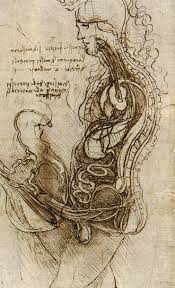
Galen held such sway in the Western world (including the Arab world where his works were translated and preserved) that Leonardo da Vinci was likely influenced by his thinking in some of his early drawings of human physiology. It is interesting that, though both Galen and da Vinci had access through dissection of human cadavers as a method of verification, they both made the mistake that there was a physical connection for the flow of semen from the brain/spinal column to the testes/penis. Perhaps this was an intentional error? The physical misrepresentation is very clear in da Vinci’s early hemisected anatomic drawings. Da Vinci’s later drawings were modified to be more anatomically correct.
Documentation of the use of sexual energy/si 12 for the evolution of consciousness through the creation of the higher being bodies in the Western world is poorly represented in a direct form. Likely, the reason for this is that this function and the methods to work with this energy were considered esoteric, held as secrets in schools/monasteries and available to only a few dedicated, select seekers. To be clear, this has not changed and publicly available information on this subject is both incomplete and inaccurate. In the past, what little was presented to the general public was masked in analogies such as Alchemists turning lead into gold as comparable to the transformation of physical food into si 12. Additionally, most of Western Occultism’s various offshoots believe man already possesses the second body, it simply needs to be worked with. With today’s emphasis on sexual gratification and the bits and pieces of information and disinformation available at the click of a mouse, it is quite easy to see how this area has become another victim to the results of the current conditions of external existence gone off the rails.
Gurdjieff himself does not speak directly to the question of si 12 transformation and how this substance can come to infuse the cells with emanations and crystallize into a Kesdjan body. But in his way, he points in a direction, though admittedly, it is confusing. For example: after telling us that si 12/being Exioëhary is the basis of the Kesdjan body, he then writes, “…the substances needed both for coating and for perfecting the higher-being-body-Kesdjan enter into their common presences through their, as they say ‘breathing,’ and through certain what are called ‘pores’ of their skin.” This is a seemingly contradictory statement that could be and often is taken that second being food (air), is the base from which substances are transformed to create the Kesdjan body. But if we look at the food diagram in Search we see that first being food (ordinary food that we eat), which enters the body as the course do 768, cannot continue its mechanical transformation past mi 192; there must be a shock to fill the mi/fa interval, and this is provided by the intake of do 192, which is ordinary air taken into the body by breath and absorbed through the pores of the skin, the beginning of the air octave. This allows the transformation of physical food to continue mechanically until it reaches the substance/hydrogen si 12. At this point it is available for transmutation and potential creation of the body Kesdjan.
There are key questions that arise for beings living an Itoklanotz existence—how can we work with this substance and do we need to do so? There is no biological need or need of nature to do so. Gurdjieff says that by having short life spans and breeding in large numbers, we satisfy the needs of nature in the maintenance and evolution of the solar system. But because we are made in God’s image and are therefore three-brained, we have the potentiality to evolve in the sense of consciousness. Are we called to do so? If the answer is yes, as “freaks,” living under the principle Itoklanotz, we must, as Gurdjieff says, engage in, “being-Partkdlog-duty [conscious labors and intentional suffering], which realization alone enables a being to become aware of genuine reality…” and to “…acquire in their presences the data for coating their said higher being parts.”
| Is celibacy/abstinence needed? Gurdjieff is somewhat agnostic on the question of abstinence. That is, as to the question of whether abstinence of “normal” human sexual activity of an external nature, is a help, hindrance or of no effect as to the work of people on a path of the evolution of consciousness. It’s a yes, no and maybe answer he gives in Search. (pp. 256 257) It depends on type, there must be abstinence in all centers and so on. He says, “People have tried abstinence from times beyond memory. Sometimes, very rarely, it has led to something… That until he [any man] has new and exact knowledge it will be quite enough if his life is guided by usual rules and principles.” (Search 257) It is important to remember the context of these statements. Gurdjieff is almost certainly speaking to people that have already reached the age of responsible existence. In the context of people before the age of responsibility Gurdjieff, through his tutor Dean Borsh, presents an entirely different teaching. Borsh says, “If a youth gratify this lust before reaching adulthood…he will lose the possibility of being a man of real worth.” (Meetings 54) The age of adulthood Borsh says is for a man between 20 and 23 and a woman 15 to 19. In Borsh’s opinion after this responsible age is attained, sexual abstinence can be foregone, though he emphasizes the importance of finding a compatible mate. So, we have two different views of abstinence, related to the attainment of the age of responsibility and thereafter. There cannot be enough emphasis on how important these early years are as to the possibility of the evolution of consciousness. Gurdjieff over and over makes this clear, even to the point at the end of the First Series, in his beautiful comparison of human life to a large river, where in there is a dividing of the waters for men upon their reaching responsible age or adulthood. If a man has attained his own “I” before responsible age he enters one stream, if not the other. To attain one’s own “I” is in effect an attainment of a Kesdjan body, at least, at an embryonic level. While Gurdjieff says that it is possible to attain this after the age responsibility is reached, he writes that it is “not so easy” to, in adulthood, cross from the stream of multiple “I”s to the stream made up of people that have an individual “I”. This may be a rare instance of Gurdjieffian understatement. |
—Richard Myers— http://www.growingchoongary.com
Notes
- At the base of their spinal column. G.I. Gurdjieff, All and Everything, First Series, 88-89.
- Can we doubt. Charles Darwin, The Origin of the Species (Barnes & Noble, 2004), 74-75.
- This time agitating chiefly. Gurdjieff, 271.
- Began to seek out. Gurdjieff, 277-278.
- There now exist. Gurdjieff, 280.
- Brachyury is a member of a protein family. Medline Plus, “TBXT genes,” https://medlineplus.gov/genetics/gene/tbxt/.
- The mutation. New York Times, “How Humans Lost Their Tails” Sept. 21, 2021, 9https://www.nytimes.com/2021/09/21/science/how-humans-lost-their-tails.html.
- For three-brained beings of the male sex. Gurdjieff, 712.
- Sex plays a tremendous role. P.D. Ouspensky, In Search of the Miraculous, 254-255.
- Abnormal conditions. Gurdjieff, 105.
- Everything connected with sex. Ouspensky, 258.
- The physical body. Ouspensky, 256.
- Without fail until their second-being-body-Kesdjan. Gurdjieff, 437.
- The sexual act originally. William Patrick Patterson, Voices in the Dark (Arete Communications, 2000), 47.
- That in the beginning, after the organ Kundabuffer. Gurdjieff 131.
- A true human tail. Sultan Qaboos Univ. Med. J. Feb. 17, 2017 A True Human Tail in a Neonate,” https://www.ncbi.nlm.nih.gov/pmc/articles/PMC5380406/.
- As a direct translation. Oscar Sugar, PhD, MD, JAMA, “How the Sacrum Got Its Name,” Apr. 17, 1987, https://jamanetwork.com/journals/jama/article-abstract/365627.
- Kundalini is the power of imagination. Ouspensky, 220.
- The semen – as Plato. Sergio Musitelli and Ilaria Bossi, SciMedCentral, July 6, 2016, “A Brief Historical Survey of Generation (From Hippocrates (469-399 B.C.) to the Controversy between Spermatists and Ooists,” https://www.jscimedcentral.com/ReproductiveMedicine/reproductivemedicine-1-1002.pdf.
- The substances needed. Gurdjieff, 569.
- Acquire in their presences. Gurdjieff, 438.
 Open to Openness